We have seen how the dreams of the original group of communists were tried at Totley and how they faltered. Before they finally ended in disappointment and recrimination, Ruskin placed the experiment in the hands of a notable working-class socialist and republican, William Harrison Riley. In this seventh post of the series, Stuart Eagles begins his examination of a long-neglected account of Ruskin written by Riley in 1890 and published in an American journal.
We start with a visit Riley made to Brantwood to see Ruskin in January 1879. We then look at how Riley represented Ruskin to his American reader. Finally, we scrutinize Riley’s account of Ruskin’s correspondence with him.
RUSKIN & THE COMMUNISTS
(PART 7)
AN UNEASY FRIENDSHIP:
WILLIAM HARRISON RILEY AND JOHN RUSKIN
Stuart Eagles
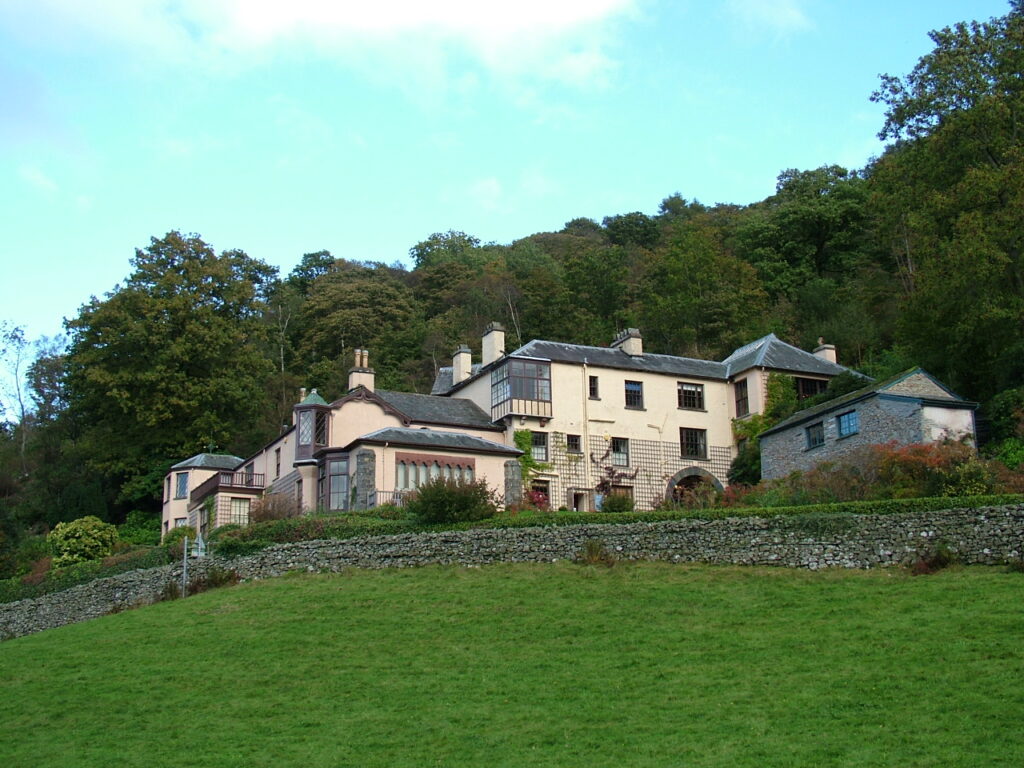 Brantwood, Ruskin’s home
A VISIT TO BRANTWOOD
On Wednesday and Thursday, 15 and 16 January 1879, William Harrison Riley (1835-1907), an idiosyncratic type of Christian socialist, a Companion of John Ruskin’s Guild of St George, and a Guild retainer whom Ruskin had put in charge of the Totley estate nearly a year earlier, met with Ruskin at the sage’s Lake District home, Brantwood, on the shores of Coniston Water.
Ruskin’s invitation, which had been somewhat long in coming, read:
“I was only waiting till the weather was milder, thinking the travelling too wretched for you, but I shall be glad to see you as soon as you like to come. You had better come by a good midday train, sleep at Mr Sly’s Waterhead Inn [in Coniston: this is Joseph Sly (1815-1895)], and come over here to lunch at one, next day.” (Qtd in Riley (1890) p. 349)
Riley quoted this letter in a 7,000-word article he published anonymously (as “a Companion of the Guild of St George”) in The Illustrated American in 1890. America’s first photographic weekly, it was a new journal for a relatively affluent and well-educated readership. Broadly progressive and reformist, it was also nationalistic and patriotic. It endured until 1900. Riley’s article appeared more than a decade atter the events it describes.
Referring to Ruskin’s invitation, Riley directed readers to “[n]ote the simple style of the letter, in which the great master of the English language has used nineteen consecutive monosyllables” (Riley (1890) p. 349).
Riley’s account of his visit to Ruskin at Brantwood is worth quoting at length. It reveals a great deal about Riley’s relationship with Ruskin at the time. It provides unique evidence of one visitor’s experience of Brantwood life, as rich in detail as it is in charm, and though Riley is respectful of Ruskin and fond of the memories he shares, he is also frank in giving opinions that reveal an attitude that was not always positive towards Ruskin. Crucially, this material is unfamiliar, having been overlooked by scholars until now.
By the time Riley wrote this account, his relationship with Ruskin had completely broken down. Riley had left Totley ten years earlier, and had emigrated to the United States of America where he would live out the remainder of his life. Ruskin and Riley would never be reconciled. Yet Riley would always regard his engagement with Ruskin as a valuable experience which, for all that it ultimately fell short of both men’s expectations, and engendered a sense of grievance for them both, Riley could never quite bring himself to regret.
The arrangements for Riley’s visit to Ruskin at Brantwood were agreed. He was met at the railway station by “a groom on horseback” who told him that “Mr Ruskin had instructed him to direct me to the inn, where I went and had a very pleasant time with one of the masters of Eton College” (Riley (1890) p. 349).
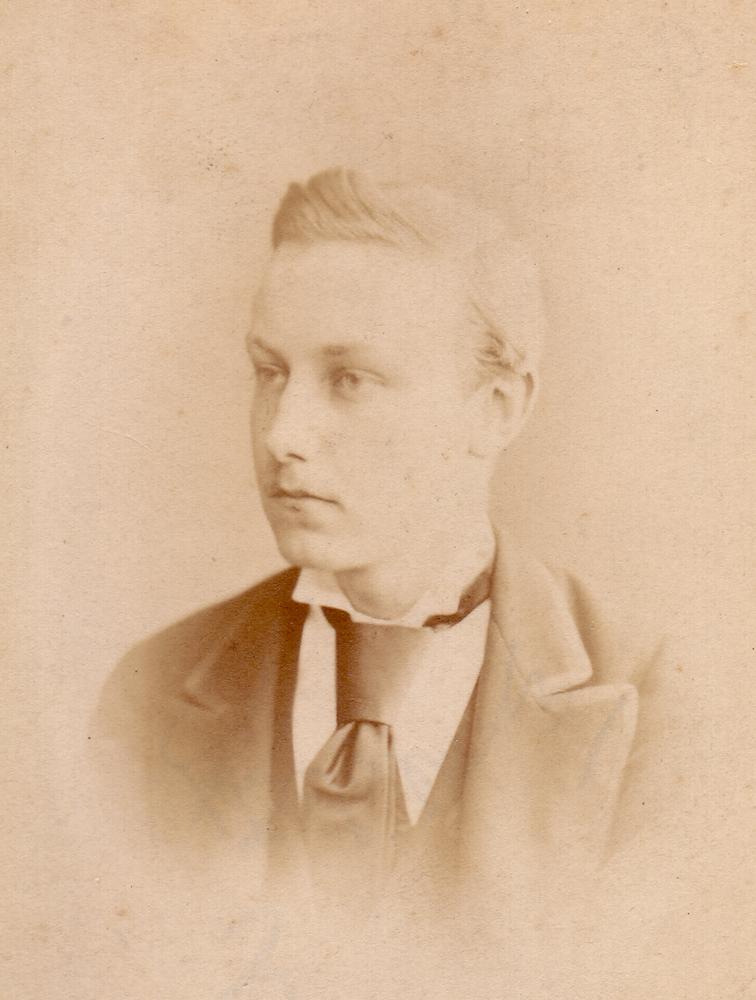 Henry Salt
This was Henry Salt (1851-1939), now remembered as an author, campaigner, ethical vegetarian, anti-vivisectionist, socialist, and pacifist. In January 1879, he was a 27-year-old teacher of Classics at his alma mater, Eton College. He had taken up the post in 1875 after graduating from King’s College, Cambridge. He would relinquish the position in 1884.
The day after Riley arrived in Coniston was “a very rainy one”, and Riley received a note from Ruskin:
“Unless the day quite clears (which is little likely) I would rather you did not come to-day, as I could not show you anything of the place. You had much better ask Mr Sly to let you have a guide to the tarn above the copper mines, returning by the foot of the waterfall from the highest tarn, above the quarries. This last will be very splendid to-day, and there will probably be remnants of ice at the other falls still well worth seeing, besides the streams themselves. It will be quite worth while going to bed afterwards to have your clothes dried. If to-morrow is no better you must come, wet or dry. If well I will have Mr Sly’s closed fly [i.e. horse-drawn carriage] to bring you round.” (Riley (1890) p. 349)
The 43-year-old Riley took Ruskin’s advice, and climbed Coniston Old Man, Henry Salt having volunteered to act as his guide. Riley recounted:
“[W]e set out in a drenching rain and got lost in a fog somewhere below the slate quarries, which are more than half way up the mountain. But we found the places named by Ruskin, although to do so we had to remain on the mountain until long after sunset. Early next morning, which was fair, I climbed the mountain alone, and in the snow near the summit saw the footmarks of some one who evidently had taken prodigiously long strides. These, I learned, were the footmarks of Ruskin, who had been up the mountain a few clays before my arrival.” (Riley (1890) p. 349)
Henry Salt later recalled, in his own short account of this meeting, that Riley explained to him his “communistic views” on those long mountain walks in Coniston: it “open[ed]” Salt’s eyes “to certain facts which I had previously overlooked” (Salt, p. 61).
Having returned to the Waterhead Inn, it was time to set off to Brantwood. Ruskin’s cousin and housekeeper, Joan Severn, met Riley at the inn, bringing with her an invitation from Ruskin for Salt also to join them at Brantwood.
“We were very cordially received at Brantwood, Ruskin holding out both hands to be shaken—to each in turn.” (Riley (1890) p. 350)
Salt tells us rather more about this greeting than Riley does. Riley had decided to collect a clump of moss from a wall, but as moss was so abundant in Coniston, Salt had tried subtly to discourage him. Salt explains:
“Disregarding such hints, [Riley] arrived at Ruskin’s door with a big parcel of the moss, and gravely presented it as soon as the first salutations were complete. The delightful charm of Ruskin’s manner was seen in this little incident: he laughed — for who could have helped laughing?—yet took the gift—and turned the subject—with a graciousness that could leave no hurt.” (Salt, pp. 60-61)
Salt made note of “the devotion of the follower, and the geniality of the sage”, but was probably unaware that Riley had presented the moss fully understanding “the significance of humble natural phenomena” to Ruskin—as the scholar Mark Frost, one of the few to look seriously at Riley’s personal correspondence, has put it (Frost (2013) p. 64).
Riley’s account continues:
“Soon after our arrival we were taken to lunch. Some excessively fat mutton was served, but Ruskin contented himself with a glass of sherry and a wine-biscuit. He was very lively and talkative. He began by speaking of Sheffield, its work and its workmen, and rising hastily from the table, he fetched a steel model—a yard long—of a swallow’s wing-feather. The model, he said, was made for him in Sheffield, and was not quite satisfactory. Its purpose was to illustrate the propelling power of a bird’s wing-feathers. He beat it up and down, and called our attention to the forward tendency the perpendicular motion caused, and he asked us to try it ourselves.”
[NB. This was the “enlarged model of feather (in steel)” costing £3 and listed in the Guild’s accounts in the first half of 1878 (see Ruskin, Works, 30:114). It is referred to in a letter from Ruskin to Henry Swan: “I’m very glad that [Benjamin] Creswick’s father [Edward Creswick (1810-1897)] is making the feathers. Steel or iron all’s one to me” (received 29 January 1878).]
“After resuming his seat at the table he spoke of the Coniston—or Ambleside—sunsets, which had not come up to his anticipations. He said they were not nearly so grand as the Scotch sunsets, and that he suspected the copper in the mountains caused the difference.” (Riley (1890) p. 350)
In fact, Ruskin would write in his diary on 17 January 1879 that he had seen “the purest and loveliest sunset I ever remember seeing here with rayed shade […] softening the hither shore, the lake more than ½ frozen, giving strangest broken reflections in dead calm and the mist above it taking the rays” which he sketched on the opposite page (Viljoen, pp. 149-150).
Riley recounts that Ruskin pressed him and Salt for “a description of what we had seen on the mountain, but ceased when we confessed our lack of descriptive power” (Riley (1890) p. 350).
Riley proceeds to give readers unflattering insight into Ruskin’s bluntness.
“After luncheon [Ruskin] invited me to his study to talk over business matters. When they were concluded he began to talk on general subjects, including poetry; and while speaking highly of Tennyson’s abilities and character, lamented that he had, with few exceptions, chosen themes unworthy of his genius. (The only exception he named was ‘In Memoriam’.) Then he spoke of the mysteries of evil, and said: ‘We have got to believe in the devil;’ and, after nervously pacing the room a few times, he began to laugh heartily, and said: ‘I often laugh when I think of your gun-powdery letters’, and he told me I had ‘no more reverence than a mosquito’. He always required recognition of his greatness. To one visitor he said: ‘Don’t you know that the noblest in Europe would visit me if I would let them?’” (Riley (1890) p. 350)
It is as if, having disclosed Ruskin’s criticism of his letters, Riley had quickly to get his own back by presenting Ruskin as vain.
When Riley visited Ruskin at Brantwood again the following day (16 January), he went alone. Ruskin noted in his diary that he had “worked in [the] wood” and Riley recalled that Ruskin “took me outdoors’.
“His house is situated on the shore of Coniston Lake, and when he bought the house the grounds in front, extending to the water’s edge, were rough and unsightly. He showed me how he had terraced the grounds, and said he was very proud of the engineering skill he had displayed. He had a bill-hook in his hand when he went out, but soon dropped it on a garden-bed. Like Gladstone, Ruskin loved wood-chopping, but his chopping was of a less thorough kind than that of the statesman. Ruskin cut down only small trees, and always used bill-hooks. I use the plural with premeditation, as he had a habit of tossing his bill-hook down whenever he felt that it encumbered him—as, for instance, when he saw a patch of moss of which he wanted a specimen. The bill-hooks thus tossed down were never again found by him, except by accident. No bill-hooks but those made by the Coniston blacksmith would suit him, and he always ordered them by the dozen. His method of chopping was remarkable. He would not stoop, and consequently the stumps he left were from three to four feet high and had to be cut clown by a hired man, who could have cut them more easily if the tops had not been removed.
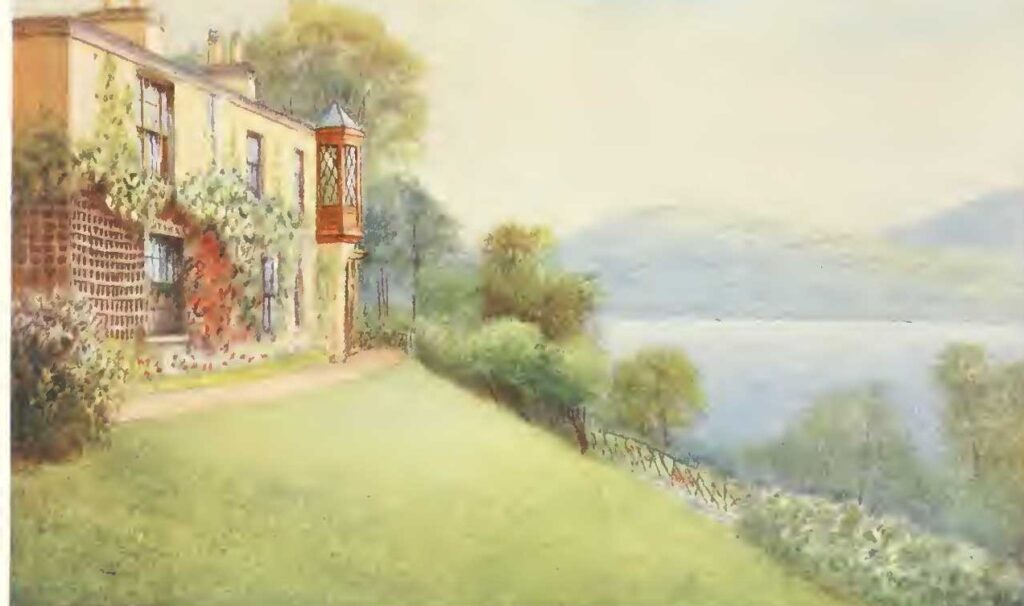 Brantwood, Ruskin’s home, by Emily Warren
“After some talk on St George’s business we returned to the house, and he took me into his study. On the writing-table was a large piece of crystal, weighing four or five pounds. It was in its natural state, except on one angle, which had been ground, polished, and engraved with his motto—‘To-day’.” (Riley (1890) p. 350)
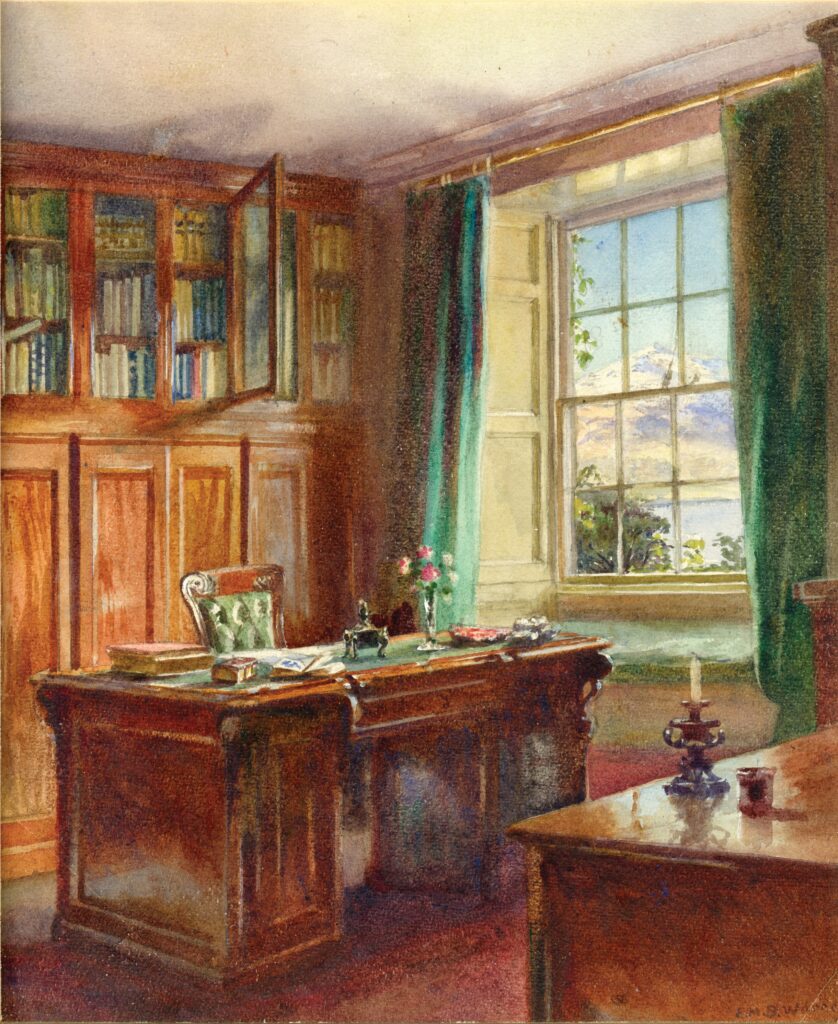 Ruskin’s Study, painted by Emily Warren
When it came to the interior of Brantwood, Riley confessed the inadequacy of his descriptive powers for a second time, particularly when it came to giving any account of Ruskin’s remarkable collection of Turner watercolours. He wrote:
“I was rather startled by Ruskin telling me that a rough black-lead sketch I had made and sent to him of the St George’s buildings at Totley was ‘very good’, as I considered I knew no more of the art of drawing than of the method or methods of calculating the orbit of a comet. [Sadly, the sketch does not appear to have survived.] I liked most of the pictures I saw [at Brantwood]. I have seen Niagara and liked that, but I cannot write an interesting description of it. Something I observed that I thought was remarkable in the great art critic’s home—a carpet with flowers that were not conventionally drawn, and one distressingly heretical table-cloth.” (Riley (1890) p. 350)
Riley was neither the first nor the last visitor to question the master’s taste in interior design. See, for example, the letter that another Guild Companion, Katherine Bradley (1846-1914), wrote to her niece, Edith Cooper (1862-1913), on visiting Brantwood in August 1882. (Together, the women—who were also lovers—published poems and plays under the pseudonym Michael Field.) Bradley, whose powers of description certainly trump Riley’s, noted the “rich shades of red in the turkey carpet” of the drawing-room, about which she expressed no opinion, but she disliked the wallpaper which “looked very much like the pattern of a large flowery dressing gown”; moreover, she bluntly declared that the study was “not beautiful”:
“too crow[d]ed and scientific looking piled with Cabinets and book-Cases—except in the wondrous corner, where at a little round table the Master works by the window. We saw his seal—the motto “To-day” inscribed on the finger-tip of a solid Mass of stalactite and his favourite 13th century Missal, and had a peep at his minerals.” (Qtd in Buckle (ed.), p. 57)
Riley made some other unflattering observations which we can take to be more reflective of his general feelings about Ruskin at the time he wrote the article (1890) than when he made the visit to Brantwood (1879). Ruskin, he said, “attached as much importance to punctuality as to obedience—in other people”:
“I had not found him to be always punctual, and Mr Sly, when I returned to the inn, showed me the following note he had received as collector, and which suggests that Ruskin was not always punctual with his taxes, and lost his tax-papers as he did his bill-hooks: ‘I’m so glad that you’re the Collector—for I’m always losing my tax-papers and expecting the Government to come and seize my Turners and lock me up. But I shall look to you to prevent the catastrophe.’” (Riley (1890) p. 350)
WALT WHITMAN
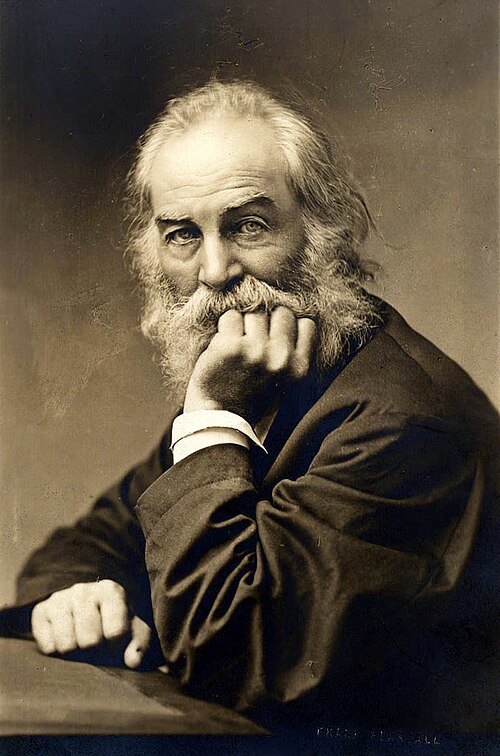 Walt Whitman in 1869
Ruskin was not the only prominent nineteenth-century figure with whom Riley was acquainted. We will see in subsequent blog-posts that, for a brief period in the early 1870s, Riley knew and worked with Karl Marx. Mark Frost has pointed out that Riley’s “collected papers include letters from William Rossetti, Karl and Eleanor Marx, Edward Carpenter, Walter Besant, and Rudyard Kipling” (Frost (2013) p. 73). But Riley was most fond—and felt most indebted to—the American poet and prophet, Walt Whitman. It was on discovering a first edition of Whitman’s Leaves of Grass in Boston in 1867 that he was converted to socialism. He classed Whitman with Carlyle, Emerson, and Thoreau (see Frost (2013) p. 69).
Riley’s article about Ruskin is split into six sections, and the fourth is dedicated to Whitman. It is worth reproducing Riley’s account in full, not merely for what it reveals about Riley’s estimate of Whitman, but more pertinently what it tells us about his relationship with Ruskin. There was something like a missionary zeal in Riley’s desire to promote Whitman to his friends. It was clearly of the utmost importance to him to feel that Ruskin shared his enthusiasm for the American poet-prophet.
“After returning home from Brantwood [in January 1879], I sent Ruskin some extracts from Walt Whitman’s Leaves of Grass. It appears, from the answer I received, that the master had never before heard of Whitman or read any of his writings. These are a few of the extracts.
“‘And no man understands any greatness or goodness but his own, or the indication of his own.’
“‘The great city is that which has the greatest men or women; If it be but a few ragged huts, it is still the greatest city in the whole world.’
“‘Where the city stands with the brawniest breeds of orators and bards;
Where the city stands that is beloved by these, and loves them in return, and understands them;
Where no monuments exist to heroes but in the common works and deeds; …
There the great city stands.’“Ruskin’s acknowledgment was in these words (given in fac-simile):
“Dear Riley,
“These are quite glorious things you have sent me. Who is Walt (Walter?) Whitman, and is much of him like this?”
“Ever gratefully yrs,
“J. Ruskin.
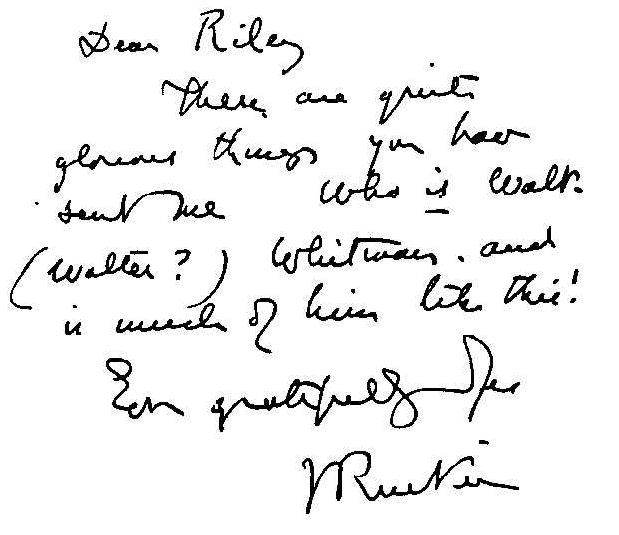
The facsimile reproduced in The Illustrated American (Riley (1890) p. 350).
“I never before knew Ruskin to praise anything in such enthusiastic terms, and to emphasize his appreciation of the lines I had sent he signed his name ‘Ever Gratefully Yours”—a form of subscription I had never before seen in any of his letters, and I have seen many and know that he was as particular about the form of subscription as of any other part of his letters.
“When answering the note I spoke of the difficulties Whitman had had with his publisher; of his being robbed by agents; of the lack of appreciation of his writings (in America); of his work in the hospitals, his sickness and poverty, and of his dismissal from office in Washington [in 1865] on account of his writings [though in fact he was quickly reappointed to a better position]. I also promised to forward to Brantwood my copy of Leaves of Grass. The response—written in London—was as follows:
“‘Your letter was sent on here. I am very glad to know that I can give some pleasure to such a man. I will write to him directly. Send the book to Brantwood.
“‘All that you tell me is more frightful than I care to write of.’
“The note was subscribed ‘Ever very Gratefully’, and thus conveyed an assurance of his continued approval of the extracts. After describing the correspondence to Whitman, I received from him this letter:
“‘Your letter has reached me here and I thank you for your affectionate warmth and appreciation. I have long wanted to do myself the pleasure of sending a book of mine to Mr Ruskin, and I have sent one—also a couple of photographs—directed to him to your care by the same mail with this—same address.’ [This letter was dated 18 March 1879 and can be viewed online here: <https://whitmanarchive.org/item/loc.04038>.]
“About two months after Whitman’s package had been received by Ruskin, he visited St George’s farm at Totley [presumably in October 1879], where I was living. I asked him if he had written to Whitman, and he said he had not. Then I reminded him of the promise to write ‘directly’, and told him I had informed Whitman of the promise. [Letters, dated 5 March 1879 and 4 April 1879, can be viewed online here: <https://whitmanarchive.org/item/loc.03351> and here: <https://whitmanarchive.org/item/loc.03354>.] ‘Well,’ said the master, ‘I will write to him in a few days.’ He did so, but I thought of his motto ‘To-Day’, and of the very elastic use he had made of the word ‘directly’.” (Riley (1890) p.p. 350-351)
[The Ruskin-Whitman correspondence has not survived.]
Nevertheless, Riley would write later that “The only time that I was in the company of Walt Whitman, he asked me—referring to Ruskin—‘How is the good man?’” (Riley (1903) pp. 5-6).
Mark Frost has shown that Riley wrote Whitman “three adoring letters” in the spring following his meetings with Ruskin in Brantwood and Totley (January and February 1879) in which he addressed him as his “dear friend and master” and once called him his “faithful pupil and lover” (i.e. admirer) (Frost (2013) pp. 75-76).
Riley also recalled that although Karl Marx had not been familiar with the works of Whitman until Riley drew them to his attention, he was “well pleased” and “greatly interested” when Riley quoted some of his lines. Marx also reportedly “spoke approvingly” of Whitman’s treatment of theology (Riley (1903) p. 6).
Mark Frost enumerates the essential differences between Whitman and Ruskin that effectively doomed Riley’s private campaign to connect the two men in any meaningful way.
“Whitman’s democratizing disgust for organized religion was associated with a distaste for European feudalism, while Ruskin rested his entire social and aesthetic vision on valorizing mediaeval culture and was deeply critical of democratic politics. […] Whitman believed in the providential role of the United States in forging a new kingdom of God, while Ruskin disparaged the former [British] colony, campaigned against unauthorized American editions of his works, and told Fors readers that ‘though I have kind invitations enough to visit America, I could not, even for a couple of months, live in a country so miserable as to possess no castles’” (Frost (2013) p. 77).
Tellingly, there are no references to Whitman in the Library Edition of Ruskin’s Works.
[NB. For full transcripts and scans of Riley’s other letters to Whitman, see the Walt Whitman Archive online here: < https://whitmanarchive.org/search?q=%22William+Harrison+Riley%22>.]
RILEY’S VERDICT ON RUSKIN
Riley’s opening remarks in his article of 1890 sympathetically introduce Ruskin to the magazine’s readers. Riley presents his own idiosyncratic Christian socialist version of Ruskin, but is otherwise a mostly straightforward and accurate account of the key facts of Ruskin’s life. (Riley does suggest, however, that Ruskin moved to 54 Hunter Street when in fact he was born there, and though Herne Hill is mentioned, Denmark Hill is not, see Riley (1890) p. 347.)
Riley’s evaluation of Ruskin’s merits is generous. Ruskin’s prose, he asserts, “is instinct, nay is fragrant, with poetry” (Riley (1890) p. 347). Riley’s sympathetic, sincere, and eloquent appraisal is worth quoting at length. Whatever disagreements he would come to have with Ruskin, it did not prejudice him against Ruskin’s obvious merits. He never disputed Ruskin’s pre-eminence as a writer on a wide variety of topics, particularly the subject closest to his own heart—social justice. In this last regard, Ruskin is presented as admirably heterodox, even heretical.
“Ruskin has been a master of many arts—poetry, prose, painting, geology, botany. He has inspired and instructed sculptors and architects, and has introduced a soul into the body of political economy. His vision has been wonderfully comprehensive and penetrative, unlimited by orthodox rules and unobscured by popular traditions or conventional hypocrisies. No man more quickly than he could distinguish what is divine from what is devilish. Although he called himself ‘an old Tory’, he has really been a great radical reformer. There are few forms of extortion that have been too subtle to escape his recognition and condemnation, and none too respectable to be branded by him as (simple or compound) theft. […] He has been almost as radical as Jesus of Nazareth and as valiant as St George of Cappadocia.” (Riley (1890) p. 347)
Riley worshipped Jesus as the exemplary socialist: his ideological forebear as communist and republican. In a short article in The Christian Socialist, Riley took issue with the atheism of the Darwinian and socialist, Edward Aveling (1849-1898), who had recently become the partner of Karl Marx’s youngest daughter, Eleanor, and would be taken under the protective wing of Friedrich Engels after Marx’s death. In a manner typical of Riley’s political writings, he valorized Jesus as the “Communist of Nazareth” (see Riley (1884) p. 182). Christianity cannot be discredited by those who misrepresent it, he argued, and Christian socialists must “combat the corrupt churches” which have become the “tools of the usurers” (one of Ruskin’s favourite enemies).
A FRIENDSHIP KINDLED IN LETTERS
In his article on Ruskin, Riley selects passages from letters he received from Ruskin between 1872 and 1880, noting that there were “occasional wide intervals” between them (Riley (1890) p. 347). The correspondence had begun, Riley recounts, when Ruskin published a critical response to the “radical paper” Riley then edited in London. “At the outset of my correspondence with Ruskin”, Riley claims:
“we—mainly at his instigation—got into a controversy, a portion of which he published in Fors Clavigera. He gave me no opportunity to revise my share, although most of it was written without any idea on my part of its being published.” (Rilet, p. 349)
A similar complaint was voiced by Octavia Hill when Ruskin published their fraught private correspondence in 1877.
Riley was referring to the response Ruskin gave at the end of Letter 25 of Fors in January 1873, being solutions to 11 “interrogations” (i.e. questions!) that Riley sent him (see Ruskin, Works, 27:470-472). Ruskin had refused Riley’s invitations to ask him anything he liked. Instead, he offered to answer Riley’s questions. Choosing not to name Riley, Ruskin described his correspondent as a “Republican of literary tastes, who wished to assist me in the development of my plans in Fors” (Ruskin, Works, 27:470).
Ruskin’s responses to Riley can only reasonably be characterized as dismissively curt, and end with this stinging rebuke:
“See Fors Clavigera, throughout, which indeed I have written to save you the trouble of asking questions on such subjects.
“It might be well if my Republican correspondent, for his own benefit, would write down an exact definition of the following terms used by him:—
-
‘Private Property.’
-
‘Tax.’
-
‘State.’ (Ruskin, Works, 27:272)
That a friendship might subsequently develop following Ruskin’s “gunpowdery” salvoes in print seems improbable in the extreme. It is testimony to Riley’s equanimity, and Ruskin’s sincerity that it did.
The passages Riley selects and shares from Ruskin’s letters emphasize Ruskin’s insightfulness, his complexity, but also his hypocrisy. The frankness of the exchanges between the two men reveal an intimacy of which Riley, writing in 1890, was proud and regretful of its loss. For instance, he quotes Ruskin confiding
“I write as in a fighting ship—not always of battle—but never without consciousness of its nearness.” (Qtd in Riley (1890) p. 348)
It was a pain to write, Ruskin remarked, because he was always deliberate in his utterances, and “impatient words” were “impossible” to him at that point (qtd in Riley (1890) p. 348). If he sounded “haughty and proud”, it was not because he thought himself the greater man, but that he took great pains in “doing my best to know the whole truth of it” (qtd Riley (1890) p. 348). This arguably implied that Riley did not, but Riley seems genuinely to have respected Ruskin’s thoughtfulness.
Riley summarizes “some of Ruskin’s teachings” for readers of The Illustrated American, and he never disguises or obscures the differences between Ruskin’s views and his own (Riley (1890) p. 347). Most people might have something to teach, Ruskin told him in one letter, but they ought not necessarily try and do so:
“I could perhaps preach as good a sermon as many clergymen; but I never get up to speak in my pew.” (Qtd in Riley (1890) p. 348)
People should be educated to recognize and accept the occupation to which they are best suited. Riley summons Biblical verses and Ruskinian simile to sum up Ruskin’s message: “Knowing the truth, they shall be free. They shall be as industrious as bees, as cheerful as squirrels, and as obedient (to the laws of God and Nature) as lilies of the valley.” (Riley (1890) p. 347) Riley’s is also summing up his own utopianist sympathies.
Ruskin, Riley goes on, believed that “the best servant […] should be master of all”, God being the “chief servant” (Riley (1890) p. 347).
People should love their king, and Ruskin—“rightly” Riley adds—rejected usury altogether; it was, Riley insists, Ruskin’s “most valiant” attack, and it is notable that Riley’s own writings on political questions, as we shall see, increasingly targeted usury as one of the great evils of modern capitalism.
On a more personal note of disagreement, Riley notes:
“the plutocratic arrangement that many people call a republican form of government, but which really is a rejection of all true government, he regarded as the worst of all” (Riley (1890) p. 347).
From what Riley describes as “one of the first” letters he received from Ruskin, dated 15 December 1872, he quotes the following:
“the entirely different views of matters which may be taken by two persons having exactly the same main purposes—(for you and I are both at work with the same objects) that I should say every one of the men you name as actors for good—Cobden, Arkwright, Dickens, Garibaldi and—no, I can’t say Wendell Phillips for I don’t know his work, have done quite unlimited mischief; and this I say respecting profoundly the personal character of all the four—as far as I know it.” (Qtd in Riley, p. 348)
[Wendell Phillips (1811—1884), with whom Ruskin was not familiar, was a prominent American abolitionist.]
Riley is also at pains to show an understanding of Ruskin’s sometimes harsh manner of expression. While he is generous in excusing it, he must have felt some satisfaction in exposing it.
“Many persons who have received letters from Ruskin have supposed that he wrote to them with unusual harshness. But he wrote irritably—or with apparent irritability—in some part of his letters to almost all correspondents. […]
“Ruskin wrote many letters which the recipients would not like to have published. (Indeed, to confess the truth, I have had quite an unpleasant number of that kind.) And yet, immediately following such letters would often come others full of kind compliments and sympathy. Like nature, Ruskin was very variable. He had his tempests and his calms, his light and dark days. His body was never large enough for his soul. His faults were due to his greatness. Some of his writings are the most beautiful that ever were printed in the English language.” (Riley (1890) p. 352)
Far from convicting Ruskin of abusive behaviour, Riley is unswervingly restrained in his criticism.
Yet the wounds Ruskin inflicted on Riley are hinted at even as the sense of loyalty Ruskin had initially inspired in him through his social and political writings is partially recuperated. And, as we shall see in a later blog post, Riley is frank about the practical failures that ultimately undermined the Totley scheme.
The third section of Riley’s article begins with an account of the period from 1875 to 1879 which Riley states was dominated by Guild business. He claims to have become a Companion in 1878.
Riley publishes a revealing exchange of letters which even the indefatigable Mark Frost did not track down in the trawl of American archives that so enriches his excellent book, The Lost Companions and John Ruskin’s Guild of St George (2014). It seems likely that the original documents have not survived.
Riley writes:
“In 1875 Ruskin wrote to me, asking: ‘What can you do with your own hands?’ I replied: ‘I can use a hammer and a file, cultivate vegetables, write reasonable and intelligible articles on political and social economy, and I am a natural organizer of men. Also, judging from information I have received, I think I can cut down trees as well as you can.’ (N. B. I had received some very caustic notes from him.) By return of post came this missive: ‘I don’t want to hear about your politics. What men have you organized, and what have you organized them for?’ I told him: ‘I organized the Mutual Help Association (of which you already know something), the London Labourers’ Union, and other societies. In each case the purpose was to make the members mutually helpful.” (Riley (1890) p. 349)
Not only does Riley thus lay out his credentials to Ruskin and thereby underline his suitability for the task to which he would later be appointed at Totley, but he serves himself an impressive put-down to an evidently haughty and irritable Ruskin who nevertheless may not have recognized his own poor tree-cutting.
Riley ended the first section of his article with an anecdote which he used to illustrate that Ruskin could be difficult and contradictory. He could be simultaneously sceptical and discouraging on the one hand, yet (however grudgingly) serve as a sympathetic well-wisher who offered (modest) practical help on the other. Riley’s example is an unfamiliar but not an isolated one—witness, for instance, Ruskin’s response to everything from the Kyrle Society to the university settlement movement.
“One day, in 1875, while I was residing in London, I received an invitation to call, at a specified time, at a house in Euston Road. I called, and was invited to enter by a large, heavily-bearded, well-dressed, intellectual-looking man. When I got indoors he did not invite me to take a chair, because he had none, nor any other article of furniture but an old tin candle-stick. So we stood at a window and talked. During the conversation he told me he had written a work on the ‘Future Life’, had asked Ruskin to help him to get it published, and had received a criticism in this form: ‘What do you know of a future life? You know knothing [sic] of Man, yet presume to attempt a description of God.’ Nevertheless, a check [cheque] for fifty pounds accompanied the sarcastic note. Ruskin recognized some goodness in the man, and said: ‘I will assist you this time, though I don’t think your work will do you or any one else any permanent good.” (Riley (1890) p. 347)
[Possibly a reference to the optician, Thomas Slater, a well-known spiritualist who lived at 136 Euston Road in this period.]
Ruskin was equally sceptical about Riley himself, yet he recognized his sincerity and ability and saw in him the potential that would make for a meaningful collaboration.
But just who was William Harrison Riley? Next time, Stuart Eagles provides the most comprehensive biographical sketch yet published of the man Ruskin appointed to manage the second phase of the Totley experiment.
Sources
Buckle, Sharon (ed): The Fowl & the Pussycat: Love Letters of Michael Field, 1876-1909 (Charlottesville & London: University of Virginia Press, 2008)
Carpenter, Edward: Sketches from Life in Town and Country, and Some Verses (London: George Allen, 1908)
Frost, Mark: “A Disciple of Whitman and Ruskin: William Harrison Riley, Transatlantic Celebrity, and the Perils of Working-Class Fandom” in Critical Survey, vol. 27, no. 3 (2015) pp. 63-81
Riley, W[illiam] H[arrison]: “Socialism and Christianity” in The Christian Socialist, no. 12 (May 1884) p. 182
[Riley, William Harrison]: “John Ruskin” (By a Companion of the Guild of St George) in The Illustrated American, vol. III, no. 28 (30 August 1890) pp. 347-352
Riley, W[illiam] H[arrison]: “Reminiscences of Karl Marx” in Comrade: An Illustrated Socialist Monthly, vol. 3, no. 1 (January 1903) pp. 5-6
Salt, Henry: Seventy Years Among Savages (London: George Allen & Unwin Ltd, 1921)
Viljoen, Helen Gill: The Brantwood Diary of John Ruskin (New Haven, CT: Yale University Press, 1971)
Please send any feedback to contact@stuarteagles.co.uk