We read William Harrison Riley’s account of his visit to Ruskin at Brantwood in January 1879 in Part 7 of this series. We have seen how Riley and Ruskin forged an uneasy friendship by means of correspondence. Scholarly treatment of Riley, slender as it is, tends to be vague about his life and work overall. In this eighth post on Ruskin & the Communists, Stuart Eagles provides the most comprehensive biographical account yet published of the man Ruskin appointed to manage the second phase of the Totley experiment. It helps to set Riley’s relationship with Ruskin and the Guild of St George in the broader context of a remarkable life that deserves to be better known and understood.
RUSKIN & THE COMMUNISTS
(PART 8):
WILLIAM HARRISON RILEY, A TRANSATLANTIC SOCIALIST PIONEER
Stuart Eagles
“I am glad to know that I am, to some extent, a visionary—a seer. I know that the blind—the non-seers—will grin and chuckle at this thankful confession and will continue to lead other blind men into every orthodox ditch. I will continue to respect the faculty of sight—insight and foresight—and will continue with other and greater seers to endeavour to enlarge and improve the sight of mankind, and to oppose the champions of darkness—the revilers and destroyers of sight.” (William Harrison Riley, qtd in Armytage, p. 296)
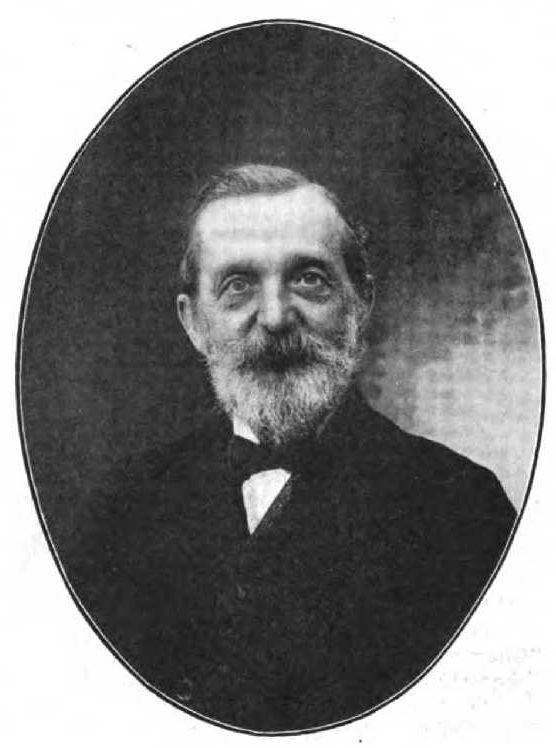
William Harrison Riley
(21 June 1835-12 October 1907)
Photograph c. 1902, published in Comrade: An Illustrated Socialist Monthly (January 1903)
PERSONALITY AND POLITICS
With admirable brevity, the socialist Edward Carpenter (1844-1929), described his friend William Harrison Riley as
“[s]omewhat under middle height, of a nervous, active, wiry build; restless, inquisitive, sensitive; of rather searching mind, stimulating and paradoxical in his talk and writing.” (Carpenter (1908) p. 205)
He also wrote of Riley that
“as a talker he was ready and effective, though—probably from excess of nervous temperament—he was never fitted for a public speaker.” (Carpenter (1908) p. 207)
Riley’s obituary in the Labour Leader had given this assessment:
“He was personally a man of great charm to his intimates, and would talk brilliantly, over innumerable pipes, for hours at a stretch.” (15 November 1907)
For most of his life Riley was an utopian socialist. He eloquently expressed his ideals through journalism and pamphlet, but always believed in praxis—wherever possibly applying his ideals in practical schemes. He was a dreamer who thought, a thinker who dreamed, and someone who strove to get things done. Despite constant disappointment, he never became disillusioned. He was feverishly enthusiastic and, notwithstanding his palpable sincerity, he never stuck at anything for long, moving on to the next opportunity full of fresh hope. His good work was never fully satisfied him and he strove for more.
His politics—though they evolved over time—were consistent in their key convictions. A convinced socialist from his early 30s, he was an internationalist, a republican, a secular Christian, and an enthusiastic supporter of the co-operative movement and trade unions.
He was a hard worker, a keen traveller, a vegetarian, a teetotaller, a smoker, and a committed chess player. He trained as an artisan (an engraver), worked for a while as a commercial traveller, and for many years lived the life of a small farmer. He was a not entirely successful political organiser and campaigner. But his metier was radical journalism.
It was as a columnist, letter-writer, pamphleteer, author, editor, and publisher that Riley excelled. His obituary in the Fitchburg Sentinel rightly asserted that he was “once a noted Socialist writer” (14 October 1907). And whilst it was an exaggeration to describe him also as “an intimate friend of Ruskin and Karl Marx”, it is nevertheless true that he was once on friendly terms with them, and worked closely with both of them at different times. As we saw in the last blog post, he was also a great admirer of Whitman and—as with Ruskin and Marx—he corresponded and met with him.
It was on discovering Whitman’s Leaves of Grass (1855) at a bookstall in Boston in 1867 that Riley was converted to socialism. “The only time that I was in the company of Walt Whitman,” he wrote in 1903,
“he asked me—referring to Ruskin—‘How is the good man?’ Marx also esteemed Ruskin most for his ‘goodness’.” (Riley (1903) p. 5)
The historian Sheila Rowbotham characterises Riley as a “cosmopolitan” figure bursting with an old Chartist energy that flowed from his first major idol, James Bronterre O’Brien (1804-1864) who believed in a fundamental restructuring of the social and economic structure by means of the political empowerment of the working class (Rowbotham (2008) p. 66).
Whilst Riley’s politics cannot be straightforwardly categorized, some core beliefs might be summarized. He despised the capitalists for robbing the workers of the full value of their labour. He advocated the nationalization of land and key public services. He was a keen supporter of producers’ co-operatives. Ha was a member of the National Reform League and of the Mutual Producers’ Cooperative Land Emigration and Colonisation Society which aimed to establish colonies in the United States (see Rowbotham (1993) p. 266; Armytage, pp. 294-298).
He also often called himself a communist. Perhaps the pithiest insight into what he meant by that was given in a short letter he wrote to the British journal, The Practical Socialist, in 1886. He starts by underlining the character of his idiosyncratic “Christian socialism”—a sort of Pauline communist. “Theoretically I am a communist”, he writes; “a disciple of the great reformer who organized a society of which it is recorded, ‘All who believed had all things common, and no man said that anything was his own’” (Riley (1886) pp. 86-87). He continues:
“Communists do not advocate an equal division of property; they advocate an equitable division. They do not believe in equalising the ownership of property, but in abolishing all ownership. They believe that all who labour according to their ability should have equitable (not equal) use of all the goods they need.”
Although Ruskin’s pre-capitalist, quasi-feudal vision of the world could accommodate most of this, the inevitable sticking point, as we shall see, was with the notion of abolishing the personal ownership of property per se. On the other hand, Riley once described a socialist as
“a person who endeavoured to improve society [so] as to have it based and regulated on the most equitable and economical principles” (the quote is from the first issue of the Socialist newspaper which Riley edited and published in Sheffield in 1877).
Riley advocated a political programme that would implement some of his most cherished principles: a cumulative income and property tax; shorter working hours; currency reform (an old O’Brienite obsession which Marx rejected); and the nationalisation of land. Much of this was neatly expressed in his draft of a British Constitution. He also believed in combination (trade unionism) but his definition of working-man meant employers as well as employees, as he pitted earners (industrialists) against non-earners (idle monopolists of capital).
An obituary in the Labour Leader described Riley as a man with a “remarkable career” who had enjoyed a “feeling of profound affection” with his comrades (15 November 1907). Living long periods of his life on either side of the Atlantic, he played bridging role in the emergence and organisation of a socialist working-class movement in both Britain and the United States of America.
As we turn to a biographical account of Riley, we will pay close attention to the development of his socialist ideals. We will also bear in mind the question we will ask in the next blog post, namely, how far did Ruskin and Riley come to accommodate their differing world-views in their collaboration at Totley, and how did it affect the second phase of the experiment?
BACKGROUND AND EARLY YEARS (1835-1870)
Riley was born on 21 June 1835 in Cheetham, on the West Bank of the River Irk, in the north of Manchester. He was the second of four children of Richard Riley (1809-1889), a fustian cutter and a Methodist lay preacher originally from Garstang, Lancashire, and his wife Alice, née Harrison (1808-1890), a silk winder and Wesleyan from Accrington. The couple had married in the Anglican church in Whalley, Lancashire, in 1831. Whie Richard could sign his name on the marriage certificate, Alice could not. The family lived in Broughton Street, Cheetham Hill, and William had one sister and two brothers. Richard was successively a draper, a master calico printer, and a small-scale oil-cloth (flooring) manufacturer who had a talent for watercolours (as did William’s brother, Richard).
William Harrison Riley trained as an engraver, like two of his paternal uncles in Manchester. He lived for a while in Accrington, drawn there, perhaps, by his mother’s relatives. In 1856, at the age of 21, he moved to the United States of America where he stayed for three years. He was based in Lowell, Massachusetts, America’s major textile centre about 25 miles north of Walden Pond, made famous by Henry David Thoreau. It was in Lowell that he got married, on 18 April 1858.
Riley’s bride, Mary Ann Palfreyman (1838-1914), was a native of Wildboarclough in the Derbyshire Peak District. She had emigrated to the US with her parents and siblings in June 1849. Her father, John Palfreyman (c1805-1854), who had been a farmer in England, set himself up as some sort of manufacturer, initially based in Dracut and later in Lowell. He died in 1854 of typhoid fever. One of Mary’s brothers, another John Palfreyman (1834-1923), was a farmer in Townsend, MA, by the turn-of-the-century—the town which William Harrison Riley would also call home at that time.
When the Rileys returned to England from America in 1859, they lived initially in Accrington. Soon afterwards, they moved to Altham, near Burnley, where William was a shopkeeper. The 1861 census, taken on 7 April, shows the family living at 6 Altham Hall Cottages. But just six days later, on 13 April 1861, they were living at New Row and blessing a new arrival—their son, George Harrison Riley (1861-1954). Perhaps a burgeoning family demanded a larger residence.
A decade after the birth of their first child, William Harrison and Mary Ann Riley had a second: Annie Palfreyman Riley (June 1871). A second child, that is, who survived. Riley confided in a letter written from Bristol in October 1876, addressed to an unidentified correspondent who had recently been bereaved by the death of his wife, that “of six children, I have ‘lost’ four” (23 October 1876).
George will enter the story again, but it will suffice here to note that his sister, Annie Palfreyman Riley, would live most of her life in America, where she served for many years as a registered nurse. She worked for several years as a district nurse in Hollis, New Hampshire, and Groton, Massachusetts. She probably returned to Fitchburg around the time her father died, and was associated as a nurse with Burband Hospital on Nicholas Street. On 11 July 1920, aged nearly 50, she married Frederick Nelson Miles (1877-1953), a native of Lowell and an employee at Hardy’s machine shop. The couple were wed in Rollstone Congregational Church, Fitchburg. By 1930 Frederick worked as a screen plate metalworker, and Annie as a corsetiere and later (1940) as a seamstress. She seems to have died in the 1950s.
According to his obituary in the Fitchburg Sentinel, it was in the early 1860s that Riley “became interested in Socialism and began to write on Socialist topics for the press” (14 October 1907; the same claim is made by the Western Daily Press, 4 November 1907).
Apparently dissatisfied with life in England, the Rileys once again crossed the Atlantic to the USA in 1865. During this second period living in America, Riley was connected with a jewellery business in several different towns, including Lawrence in Essex County, MA (1865) and Boston, MA, as well as Buffalo, NY. It was while browsing a bookstall in a passage off Washington Street, Boston, in 1867 that he discovered a first edition of Whitman’s Leaves of Grass, and found in it a “revolution” that converted him to socialism. [NB. His letter to Whitman of 5 March 1879 (written at St George’s Farm, Totley) makes this clear—a full transcript and a scan of the original letter can be seen on the Walt Whitman Archive: <https://whitmanarchive.org/item/loc.03351>; an editorial commentary published with his reminisces of Karl Marx which claims that the incident occurred in 1857 is incorrect (see Riley (1903) p. 6).]
Thereafter, he seems to have become increasingly involved in socialist journalism. In 1870, the Rileys once again crossed the Atlantic.
THE POLITICAL JOURNALIST AND PAMPHLETEER (1870-1875)
Back in England for the next ten years, the Rileys lived initially at 34 Belgrave Street in Leeds, Yorkshire, where Riley worked as an agent and commercial traveller for his father’s floor and oil-cloth business.
Riley’s increasingly preoccupation with socialist politics propelled him towards a career as a newspaper editor, pamphleteer, and publisher.
After making journalistic contributions to the socialist Leeds Critic, he quickly became its editor (1871), publishing the journal in Briggate. The same press issued Riley’s 16-page one-penny pamphlet, Strikes: Their Cause & Remedy (1871). He also published his Yankee Letters to British Workmen (1871), an 11-part series imparting the observations of a fictional machinist named Jack Downing.
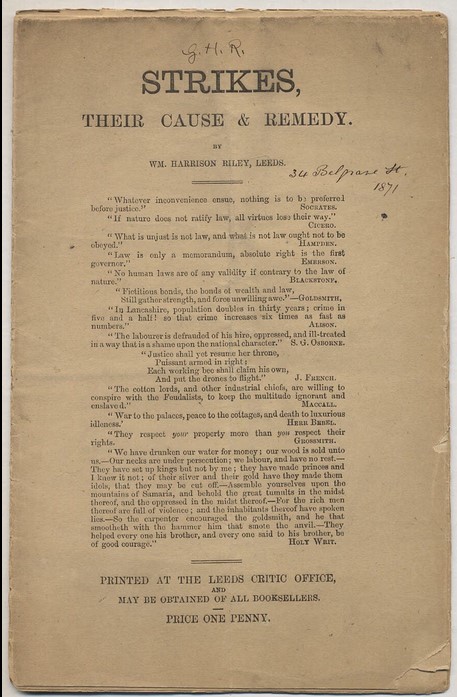
Riley’s Strikes: Their Cause & Remedy (1871)
Riley moved with his family to London in 1872, where he published An Appeal to Reason to Reform Itself. His writing, in journals and pamphlets, was characterised by sharply and often satirically expressed criticism of social injustice.
On 2 March 1872, Riley started a newspaper, the International Herald (March 1872-October 1873) which he edited and published from Red Lion Court. The first five numbers were issued fortnightly. Riley had became acquainted with Karl Marx and the wide circle of socialists and communists around him. Until recently Marx and the International Working Men’s Association (IWMA, founded 1864), of which he was effectively leader, had been little-known in Britain, though that is where they were based. Both had gained considerable notoriety in the previous twelve months as apologists for the Paris Commune. Indeed, Marx had implied, without grounds, that he and the IWMA had been the shadowy force behind its establishment.
In April 1872 Riley was elected a member of the British Federal Council of what we now call the First International. His paper, the International Herald, published accounts of its meetings. From its sixth issue, published on 11 May 1872, it became the official weekly journal of the British Federation of the IWMA. This arrangement endured until January 1873, though the paper itself continued until 18 October 1873.
The title of Riley’s paper was significant. It reflected Riley’s strong internationalist outlook. This is strongly illustrated by a piece Riley wrote in the edition of 2 November 1872, on “The Fenian Prisoners”, in which Riley, though he expressed support for Irish self-determination, nevertheless criticized the character of some Irish campaigners, and instead demanded self-determination for all citizens around the world. It was, in other words, not a concession to special pleading that was required, but the recognition of the general principal as a universal right.
Riley later recalled that Marx spoke highly of some of the Herald’s articles, but that he regarded many contributors as “patent pill mongers”, a not untypically derogatory verdict with which Riley himself nonetheless concurred.
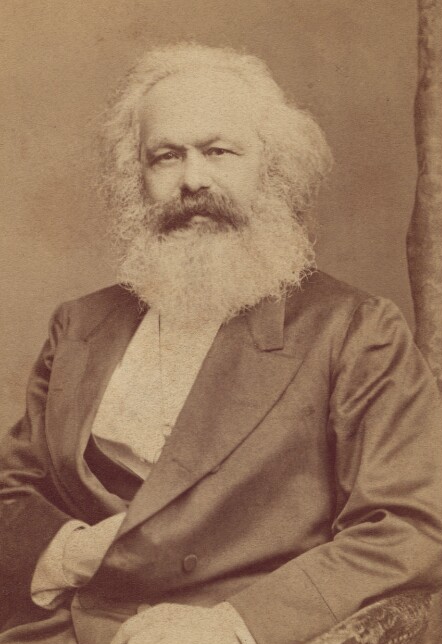 Karl Marx photographed in 1875
As Riley’s obituary in the Labour Leader explained, the IWMA was “going through very troubled waters” in 1872 (15 November 1907). Marx and his followers were in perpetual factional conflict with Proudhonists, Blancists, and most of all Bakuninian anarchists. Marx and Engels surprised the IMWA Congress in September 1872 by proposing that the Association should be run from New York. The motion was carried, and effectively killed off the organisation. The more particular troubles in which Riley was implicated related to the controversies surrounding John Hales (1839-1882), general secretary of the Council, who disassociated the British Federation from both Marx and the IWMA’s new American leadership in November 1872. These matters were the main subjects of Riley’s conversations with Marx on visits to the latter’s home at 1 Modena Villas on Maitland Park Road. Riley took Marx’s side in the dispute, and so the Herald ceased to be a mouthpiece for the British branch of the IWMA.
[NB. For Riley on Marx, see W. H. Riley, “Reminiscences of Karl Marx” in Comrade: An Illustrated Socialist Monthly, vol. 3, no. 1 (January 1903) pp. 5-6: < https://revolutionsnewsstand.com/2023/08/21/reminiscences-of-karl-marx-by-william-harrison-riley-from-the-comrade-vol-3-no-1-october-1903/>. For examples of Marx’s letters to Riley, see < https://wikirouge.net/texts/en/Letter_to_William_Harrison_Riley,_December_23,_1872>.]
Riley nevertheless promoted policies with which Marx did not agree. For example, he argued in the International Herald in favour of women’s suffrage, and outlined a future utopia in which spiritualism would be a part of a scientific curriculum of education and international languages would be taught as standard. He also believed that, in the future, there should be a systematic colonization of Mars. Marx was particularly sceptical about life after death and the existence of an intelligence superior to mankind. He once recommended that Riley contact the radical Thomas Allsop (1795-1880). In fact, the disciple of Coleridge, fiercely anti-capitalist, anti-clerical, and revolutionary, was already a friend and correspondent of Riley’s.
Asked by Marx which of the Asiatic powers would be the most powerful in the future, Riley answered Siberia. He thought France and Germany would adopt socialism first, then Spain and Italy, with Britain and the USA last. Marx reportedly replied, “I am glad to find that you are not parochial, but that you are a citizen of the world.”
Marx saw affinities between Riley’s ideas and those of the French socialist-anarchist philosopher and economist, Pierre-Joseph Proudhon (1809-1865) whom Marx had sometimes mercilessly mocked. He probably had in mind the two men’s shared faith in producers’ (i.e. workers’) co-operatives. There were also affinities between Riley and the American Noble and Holy Order of the Knights of Labor, the radical union of skilled and unskilled, men and women, and all races, founded at the end of 1869.
Riley reminisced that he
“never heard Marx talk about pictures, sculpture, or poetry (except Whitman’s). He was not what is called a ‘Sentimental Socialist’. He was rigidly mathematical.” (Riley (1903) p. 5)
The journal’s editors pointed out that Marx in fact engaged deeply with a wide range of literature. It seems likely that Riley’s judgment, given 20 years after Marx’s death, was coloured by the “scientific socialist” interpretation of Marx popularized by Engels in the 1880s. In any case, what Riley’s observation highlights is the difference between his own conception of socialism, and that of Marx. Whilst Riley defies neat categorization, he is most profitably thought of as a utopian socialist, with a pinch of Proudhon, and generous helpings of Whitman and Ruskin. Such influences took him a long way from Marx.
As the IWMA faded, Riley felt increasingly dissatisfied with the organisation. He turned first to Republicanism and then increasingly to localised co-operatives and essentially Owenite communities that bypassed the big political movements and struggles.
In the autumn of 1873 he relaunched the weekly International as the monthly Republican Herald (having initially intended to call it The Social Republican—see International Herald, 30 August 1873).
This was succeeded from April 1874 by the Herald and Helpmate which endured until April 1875. Riley published the Helpmate from his home at 7 Bedford Road in Clapham Rise. Commending the publication, the sympathetic Reynolds’s Newspaper praised “Riley’s honest democracy and fearless writings” (22 November 1874). Riley’s correspondence with Ruskin had begun at the end of 1872, and as he pulled away from Marx and the IWMA, his utopian socialism gave way to sympathy for more practical, co-operative enterprise.
As such, the Herald and Helpmate was the journal of the Mutual Help Association which Riley founded and served as general secretary. Its prospectus protested that the workers, despite being the “creators of wealth” and the “supporters of society”, were denied the product of their labour by people (the capitalist employers) “who give no equivalent in return”. Workers were reduced by the political and economic system to a kind of serfdom. Their lives were “burdensome, short, and joyless”. The remedy was for workers to band together in “due association and co-operation”. The Mutual Help Association was thus established
“for the purpose of promoting mutual support among all workers, and to discuss and consider the various means whereby the amelioration of their condition may peacefully be carried into effect.” (Reynolds’s Newspaper, 7 June 1874)
This was the development of a practical appeal Riley had first made in the pages of the International Herald in which he had told trade unionists to agitate for new leadership and make bolder demands:
“Buy from yourselves! Sell from yourselves! Make the ‘profit’ for yourselves!” (29 June 1872)
The Mutual Help Association would not be a talking shop only, but a practical point-of-exchange for goods and services that cut out the middle-men. According to the radical Reynolds’s Newspaper, by June 1874, there were branches in 13 London districts, as well as in Birkenhead, Carmarthen, Dundee, Ryde, and Warrington, and
“arrangements are in progress that will result in the establishment of branches in every town in England and Scotland, and in some of the chief towns of Ireland.” (7 June 1874)
PRINCIPLES INTO PRACTICE I: BRISTOL (1875-1877)
Up to this point, Riley had essentially been writing and talking about politics. He was to move away from editing and publishing political papers to “doing” politics. It was not a total departure. He had seemingly had a role in organizing the London Labourers’ Union, presumably when he was involved in the First International—something which he later mentioned to Ruskin—but the details remain obscure. And he would continue with occasional journalism and, after a break, would create one more journal to edit and publish. But the movement was towards practical action—putting his principles into practice. His inauguration of the Mutual Help Association produced tangible results. The final issue of the Herald and Helpmate was published in April 1875 from his new home in Bristol.
Riley had been appointed manager of the Mutual Help Club, founded in Bristol in connection with his Mutual Help Association. It opened on 3 April 1875 at 31 Phippen Street, formerly the premises of Ashmead’s ironmongers on the corner of the road facing the memorial to the tragic poet Thomas Chatterton in Redcliff Churchyard. (Details of the opening were given in the Bristol Daily Post, 5 April 1875.)
The Club was a meeting-place for workers, and provided refreshments (including alcohol) and a combined social space and marketplace in which they could equitably exchange the products of their labour on co-operative principles. The aim was to facilitate mutual improvement by means of educational lectures and social evenings. In this respect it anticipated the work of university settlements founded nearly a decade later, but it had added co-operative elements and was firmly working-class and worker-led.
Riley’s involvement in the Club would end over a dispute about the extension of drinking hours (see Western Daily Press, 4 November 1907; see also Bryher, pp. 13-15).
According to the socialist William Baster, whom we shall meet properly later, the demise of the Club was more complex, however. Some members of Riley’s Mutual Help Association began an experiment to distribute bread, meat, and fuel. It was a scheme that proved so popular that the Association was “swamped with hundreds of members” and “unfortunately only a small minority of us had any socialist leanings”: “the hunger of members for immediate advantage was the first step towards our collapse” (Justice, 30 July 1887).
In December 1875, a significant body of Club members sided with Riley n opposing an extended liquor licence. Together they formed a new Social Improvement Institute at 6 Brunswick Square. It had the same objects as the Club, with the important difference that it operated as a temperance café and vegetarian coffee shop. Riley would issue “recipes for ‘Buttered or Rumbled’ [i.e. scrambled] eggs” (see here <https://blogs.bl.uk/americas/2012/06/page/2/>).
The Institute’s committee consisted of some of Bristol’s most influential radical voices of both sexes:
- the Unitarian minister and Radical Liberal, Rev. William Hargrave (1840-1916), an amateur naturalist with an MA in botany who came originally from Leeds, and his Irish-born wife, Jane (c1842-1912);
- the anti-slavery campaigner and fellow Unitarian, Mary Estlin (1820-1902);
- the Quaker women’s rights campaigner Mary Priestman (1830-1914), a friend and ally of Josephine Butler, and later a campaigner for women’s suffrage;
- and the pioneering socialist wire worker, Robert Sharland (1850-1931), who became a lifelong friend of Edward Carpenter and the first Labour Prime Minister, Ramsay MacDonald.
Jane Hargrave was later a member of the Bristol Women’s Liberal Association, of which Miss Priestman was Treasurer. All the women, together with Rev. Hargreave and Riley, campaigned against the Contagious Diseases Acts because of the punitive measures it introduced to enforce compulsory vaccination which they saw as an attack on the poor.
Robert’s brother, John Sharland (1853-1902), an engineer, and a future Labour Councillor and Mayor of Bristol, was the Institute’s honorary secretary. The Sharlands would help found the active Bristol Socialist Society in the 1880s.
According to the Labour Leader, the Social Improvement Institute ultimately collapsed because the time was not “ripe” for it—“the fatal drawback”, they asserted, that characterized all of Riley’s “nobly-conceived schemes for the bettering of his kind” (15 November 1907). It is a charitable view, and there is no escaping the fact that Riley never seemed to stick at anything for long.
The Institute had endured for about 15 months, but when subscriptions fell and could no longer cover its expenses, it had to close. The Western Daily Press concluded that Riley’s
“efforts in Bristol were marked by difficulties and disappointments, but it is claimed that the influence he exerted had a lasting effect, and inspired others after his departure to strive for the ideals he had before him” (4 November 1907).
According to the retrospective judgement of an article in the socialist journal, Justice,
“It was from the association of Robert Sharland and] William Baster with Harrison Riley whilst he was in Bristol that the local Socialist movement had its inception, and in the early ’eighties took definite form” (10 August 1924).
Let us at last meet William Baster (1840-1908). Baster was a parcel-carrier originally from Devizes, Wiltshire (coincidentally where Henry Swan, the curator of Ruskin’s museum in Sheffield was also from—somebody else who would get to know Riley well). Baster became a prominent member of the Bristol Socialist Society, and at different times was active in radical circles in Bath and Bedminster. Like Riley, he had been a member of the First International, and he later established a branch of Riley’s Mutual Help Association in Bath. (For his obituary, see Justice, 4 November 1908).
Edward Carpenter’s explanation for Riley’s ultimate failure in Bristol was owing to personal shortcomings. Carpenter exposes a flaw in Riley’s character that is difficult to dispute:
“Riley had hardly organizing capacity enough, or consistent perseverance and staying power, to permanently carry on such a thing’ (Carpenter, p. 207).
This explains Riley’s obvious restlessness. He had a habit of never fully following through on his commitments, and falling short of realising the utmost potential of his influence. We have followed him from Lancashire to Massachusetts, back to Lancashire, and back again to the American East Coast, and again to England where he moved from Leeds to London and on to Bristol. He would then go on to Sheffield before finally emigrating to America in 1880. This betokens frenzied activity and insatiability rather than sustained application.
Yet, what Riley lacked in stamina he made up for with political daring, irrepressible optimism, and the endless yearning to help bring about a better life for his fellow workers . He had the imagination to dream. He did his best to encourage others to join him in creating a workers’ utopia. He was a whirlwind. He could ruffle feathers and win admirers, too, though perhaps at an uncomfortably high price both for himself and his cause.
A Note on Ruskin and Bristol
It is worth pausing briefly on this Ruskin Research Blog to express regret that no in-depth exploration of Ruskin’s influence on political radicalism in Bristol has yet been published. In addition to Riley’s involvement, there were several Guild Companions in the region in the 1870s and ’80s.
-
Riley almost certainly knew Hardwicke Rawnsley (1850-1921) who had worked on Ruskin’s Hinksey road scheme. He became chaplain to Clifton College mission in December 1875 and stayed until 1877. He set up a temperance and working-men’s club on Newfoundland Road.
-
Katherine Harris Bradley (1846-1914), whose description of visiting Brantwood in 1882 we quoted from in the last blog post, would later find fame with her niece Edith Cooper as the poet-playwright Michael Field. Bradley lived in Stoke Bishop for a decade from 1878, and served as honorary secretary of Clifton’s Anti-Vivisection Society.
-
Hugh Holmes Gore (1864-aft.1903) settled in Clifton and then Bristol from the early 1880s. He was an active and radical Christian Socialist, a member of Stewart Headlam’s socialist Guild of St Matthew, as well as a Companion of Ruskin’s Guild of St George. Affectionately known as the “People’s Solicitor”, he defended socialists and trade unionists prosecuted by the authorities. A homosexual, he later disappeared, and his fate remains unknown.
-
Gore’s exact contemporary, Hubert Llewellyn Smith (1864-1945) was a student at Bristol Grammar School in the 1870s. He would not become a Guild Companion until later in life, having done so much at Toynbee Hall to study the causes and effects of poverty, and having been the pivotal assistant in the civil service to William Beveridge, the principal architect of the post-war British Welfare State.
If the association of these five Companions with Bristol were not sufficient, it is worth noting the presence of other broadly Ruskinian activists, such as Edward Deacon Girdlestone (1829-1892), drawn to Bristol from Weston-Super-Mare by the pleadings of Edward Carpenter. Recommending one of Girdlestone’s pamphlets to readers of Fors, and Companions of the Guild in particular, Ruskin remarked that it was “the most complete and logical statement of Economic truth, in the points it touches, that I have ever seen in the English language” (Ruskin, Works, 28:555).
Britain’s first Labour Prime Minister Ramsay MacDonald (1866-1937) had declared himself “a full-blown social democrat” after listening to a Labour Leaguer—the young solicitor’s clerk and Christian Socialist, Robert Gilliard (1847-1923)—who delivered a paper on Ruskin, who was one of his heroes, in a “dimly-lit small upper room” at the end of a “long wooden staircase” in the Castle Street Coffee House, where the “odour of sawdust and steaming coffee” hung in the air. (See David Marquand, Ramsay MacDonald (London: Jonathan Cape, 1977), p. 17; see also Bryher 1:32). Edward Carpenter and such friends of his as Charles Ashbee and Cecil Reddie were also part of the wider radical Bristolian mix.
PRINCIPLES INTO PRACTICE II: SHEFFIELD (1877-1880)
Riley’s connection with the Guild of St George and Ruskin’s Totley experiment will be examined in detail in the next blog post. It is important to establish here, however, that Riley probably moved to Sheffield early in 1877.
It Is not clear what took Riley to Sheffield from Bristol. His wife’s family originated about 30 miles away by road, but there may not have been any relatives left in the area by the 1870s. They had previously lived in Leeds, but that is over 30 miles from Sheffield. Perhaps Riley he felt drawn by Sheffield’s well-established tradition of radical associations. We have seen in the fifth blog post of this series how Riley himself had addressed audiences at the Hall of Science in April 1874, and we read in the sixth post how Riley had published accounts by Thomas Garbutt about his Sheffield Republican Club. Some of the people Riley knew through the International Working Men’s Association had also given speeches in Sheffield in the early 1870s. Notable among them were the IMWM’s first President, the pioneering trade unionist, George Odger, and John De Morgan, a political agitator in Ireland and England. But there were other centres of radicalism that might equally have attracted Riley. Perhaps the connection with Ruskin was decisive, but it is equally possible that it played no part at all.
However it came about, Riley was definitely in residence in Sheffield by March 1877. He was based at 52 Scotland Street, the address later given for W. Freeland, his pseudonym as editor and publisher of the Socialist newspaper. It is notable that the socialists’ Commonwealth Café associated with Edward Carpenter would open at 51 Scotland Street ten years later.
By the time Riley moved to Sheffield he had re-branded himself a Christian socialist, though of an idiosyncratic type. No longer seeing himself as a communist per se, he had not abandoned the co-operativist principles that had guided his efforts in Bristol. As a Christian Socialist, Riley had relatively little in common with others who identified with the same label. His transition had been a gradual one, and Ruskin was certainly influenced his direction.
It is worth noting that at the turn of 1874 into 1875 Riley had had a disagreement—if not a row—with The Secular Chronicle. That journal had published a negative review of his book, The True Story of Jesus, told to a Child (1874). It was published in Leek by William Lamer Sugden (1850-1901) who would later become involved with William Morris and would influence Leek as an Arts and Crafts architect. Riley had argued in his book that Christ was a working man who believed in republicanism and communism, and advocated the concept of “the commonwealth” which was characterized by Liberty, Equality, and Fraternity (the rallying cry of the French Revolution).
To The Secular Chronicle, Riley was merely the latest in a long line of authors to mould Christ in his own image. They dismissed his book as a “work of fiction” (3:2 (10 January 1875) p. 17). Riley responded defensively but vaguely in the Herald and Helpmate, and the Secular Chronicle responded in turn. The Chronicle’s concluding remark set out the stark difference between their view of Christ and Riley’s: if Riley were to supply evidence of his assertions, they insisted, he
“would be conferring a great favour upon us by proving that one whom we have been inclined to regard as an impracticable and visionary religious fanatic was really a Republican martyr.” (3:2 (31 January 1875) p. 51)
No such evidence was apparently forthcoming.
In March 1877 Riley sent an appeal to the editor of the Sheffield Independent. The occasion for his letter was the staging of Jo, a drama based on Dickens’s Bleak House, adapted by J. P. Burnett (1846—1917) (who played Inspector Buckett in the production). By the time the play arrived in Sheffield it had been performed for 200 nights at the Globe and Royal Aquarium Theatres in London. It starred the renowned American actress Miss Jennie Lee (1848—1925) as Jo, a young and severely impoverished male road-sweeper. The play transferred to the provinces, first to Brighton and then to Sheffield (for a review, see the Sheffield Daily Telegraph, 6 March 1877).
“On the stage of the Sheffield Theatre Royal, last week, was represented a character called ‘Joe’” [sic], Riley wrote.
“The sympathies of the audience were excited in favour of the poor neglected, abused boy, as represented.
“My purpose in writing this letter is to solicit aid in opening, equipping, and establishing an industrial home for the poor Jo’s [sic] of Sheffield—for the orphans and outcasts of this town. It is very well to weep over the sufferings of Jo as pictured in a book or on the stage, but it is infinitely better to lend a helping hand to the living, suffering castaways who exist, not only in London, but in every large town in England.
“I desire help to open one Industrial Home (which shall be self-supporting). The boys shall be fed, clothed, employed, and educated. After one such home as I propose to open has been established, I feel sure that very many others, and on a broad scale, will be opened, and worked successfully.
“Who will assist? How many are so thorough in their sympathy as to be practical? To such of your readers as desire to help I shall be glad to send details of the plans I suggest for adoption.” (15 March 1877).
The editors added, “Mr W. Harrison Riley is unknown to us, and we express no opinion as to his claims for public support.”
Riley’s appeal does not appear to have been successful. That he was, at this point, proposing to organise what amounts to a children’s charity is testimony to the practical Christian (almost evangelical) character of his evolving notion of socialism.
Apparently thwarted in his latest ambition, Riley turned once more to journalism. In the second half of 1877, he launched a twopenny monthly, The Socialist, that promised to be
“an Advocate of love, truth, justice, industry, order, health, and beauty, and an opponent of all statutes and practices opposed to the prosperity of the people and the Commonwealth”.
Order and beauty were essentially Ruskinian ingredients folded into his utopian socialist and Christian blend.
Riley once again served as the paper’s publisher and editor for its six-month run from July to December. An early review of the paper that appeared in The Secular Chronicle expressed “sympathy and best wishes”, but went on:
“It is quite susceptible of improvement in many particulars; but as it is not wanting in ability, we are hopeful that its faults may be in time corrected.” (8:4 (22 July 1877) p. 44)
An article on Rational Education was praised as “very sensible and practical”. It had called for a more enlightened system that would not condemn boys as “stupid or lazy when they fail to perform well or assiduously work for which they are as unfit as a sheep is to worry rats”. The reviewer in the Secular Chronicle seemingly had no issue with the failure to mention girls, a fact all the more surprising when one discovers that the reviewer, “HTL”, was Harriet Teresa Law (1831-1897).
In December 1877 Riley asked in the pages of the Secular Chronicle, “Who’s for the Commonwealth?”, promoting the merits of the National Democratic League which had been founded by radical trade unionists in London in 1869 to promote full land nationalization (8:27(30 December 1877) pp. 315-316). Many NDLers had joined the International Working Men’s Association. Riley had of course been involved with what he called the “London Labourers’ Union” in a letter to Ruskin (Riley (1890) p. 349). He had adopted the Marx-Engels line in an editorial in the International Herald arguing that trades-union leaders should go to war against the slavery of wage-labour per se, rather than merely agitate for better wages in any given trade (22 and 29 June 1872).
Riley argued in his December 1877 article that society was divided into two main classes, “the earning class” and the “pauper class” which robs it. To some extent echoing Ruskin, he wrote, “We have a National Debt, but no Commonwealth” (Ruskin called it the “National Store”). The “bandit class” is honoured for gaining more and more wealth without earning it—and its members are lauded as “gentlemen”. “Labour is officially regarded and treated as a degradation” and that was why it was used as a punishment for criminals. The National Democratic League’s constitution explicitly excluded from the Commonwealth any able-bodied person who refused to work. Everyone else was a citizen with a vote, and all matters would be decided by a simple majority of the popular vote. The Commonwealth would nationalize land and water. “Food, fuel, clothing, and all other portable materials necessary for the maintenance and protection of human life” would be distributed according to need from the “public stores”. It was this radical constitution that was now demanded. The numerous piecemeal reforms, quack remedies, and attempts at labour representation had failed to produce meaningful change. His return to full-time socialist writing seems to have reignited the radicalism of his socialist politics.
In 1884, by which time Riley had settled for a third a final time in America, and his association with Ruskin had come to an unhappy and disappointed end, the most common target of his scorn had become a Ruskinian one—the “usurer”. In a letter addressed “To All Socialists” published in the British socialist journal, Justice, Riley—writing from Townsend Harbor, MA, and still deriding Liberals and Radicals—called for the abolition of all governments, which workers as the true “masters” of society simply did not need: “in their place we should have equitable voluntary association, for the benefit of each person in society” (12 April 1884, p. 7). With anarcho-communist sympathies, he argued that workers must sort things out for themselves, and only had themselves to blame if they did not.
The Totley years will be examined in the next blog post, but it is worth noting here that Riley, who almost certainly arrived on the ground at Totley in February 1878 continued to live there until shortly before he finally emigrated to the United States in the autumn of 1880.
By 1879—still then living at Totley—he was already agitating to set up communities in America under the Mutual Producers’ Co-operative Land Emigration and Colonisation Company. This adapted co-operative principles to the organised emigration of British workers to its colonies for the purpose of co-operative agricultural settlement.
For the historian Sheila Rowbotham, Riley bequeathed a valuable legacy to Sheffield. “He left a political heritage intellectually” she wrote, and in support of her claim she pointed out that “two converts, the Bingham brothers, were to become members of the Sheffield Socialist Society, later moving towards the anarchist-communists” (Rowbotham (1993), p. 269). She pointed out, too, that Edward Carpenter befriended two people Riley knew well: the scythe-maker, Albert Fearnehough, and the small farmer at Bradway, Charles Fox (see Rowbotham (1993) pp. 270-272). Rowbotham’s verdict about Riley and Sheffield matches that of other commentators focused on Riley and Bristol. Riley left his mark.
A NEW LIFE IN AMERICA (1880-1907)
Finaly settling in America for good in the autumn of 1880, Riley lived as before in Massachusetts. He wrote numerous articles for socialist journals and newspapers published on both sides of the Atlantic. He never fully lost either his utopian idealism or his belief in a brighter, and more democratic and just future for the working class.
According to the Fitchburg Sentinel, when Riley initially arrived back in America he was appointed
“editor of the Hygiene Herald, published at Boston by the eccentric W. E. Baker of the great sewing machine firm of Grover & Baker [founded in 1851]. After a year in this position his health began to fail and he retired to a farm” (14 October 1907).
He would then have been in his mid-40s. For over a decade he and his family ran a modest farm in South Row Road, near the Squannacook River in Townsend Harbor, Townsend, in the north of Middlesex County, west of Lowell. The farm afforded them a “hand-to-mouth existence”, while the bulk of his limited income came from contributing “scattered and […] miscellaneous” articles to progressive journals (sometimes under the pseudonym W(illiam) Freeland) (see Labour Leader, 15 November 1907). Riley wrote, for example, a two-part article about the political situation in the United States in the British socialist journal, To-Day, in March and May 1884. Among other publications to which he contributed were Justice, Commonweal, Comrade, The American Labor Union Journal, The Chicago Socialist, and Appeal to Reason (Kansas). He was closely involved with the work of The Haverhill Social Democrat, published in Haverhill, MA, at the turn-of-the-century, serving as an editor and a columnist.
Edward Carpenter stayed with the Rileys in Townsend Harbor and helped out on the farm for three weeks in 1884 while he was in America to visit Walt Whitman for a second time (Carpenter first visited him for a week at his home in Camden, New Jersey, in 1877). Carpenter called the son, George, a particular “chum” of his. Together, they went on several hikes, and made a kind of pilgrimage to Thoreau’s Walden (see Carpenter (1916) pp. 117-118).
Riley was still in Townsend in 1896 when he wrote a couple of letters on political themes to the Boston Globe and Boston Post, in one of which, to the latter title, he concluded by paraphrasing the line popularly attributed to Abraham Lincoln, “All the people cannot be fooled all the time’ (18 October 1896; for another letter, see Boston Globe, 28 October 1896).
Between late 1896 and 1899, the Rileys lived in Fitchburg, Worcester County, about 13 miles from Townsend Harbor. Finally, in 1899, they moved to Lunenburg, just four miles away. There they again occupied a farm. Appropriately enough, given the origins of the Totley experiment, in this period George Harrison Riley worked as a shoemaker, and lived with Godfrey Swan, the son of Ruskin’s Sheffield museum curators, Henry and Emily Swan. George was also the leader of the Lunenburg Military Band.
In Edward Carpenter’s judgement, when Riley died in Lunenburg on 12 October 1907, the 72-year-old socialist was “perhaps a little disappointed at the small success of his efforts” (Carpenter (1908) p. 209). Riley felt that socialism had developed away from him. In “A Letter from America” to the Manchester Labour Press he bemoaned the fact that anarchists were being hounded by the authorities, and also complained that the young socialists of the day had forgotten the men of the 1870s like himself “who stood in the gap” (29 September 1894).
To his credit, Edward Carpenter recognized Riley’s role “in the gap” very precisely. Riley, he wrote, was one of those noble socialists who
“bridg[ed] over the interval between the old Chartism of ’48 and the Socialism of the early eighties, and [kept] alive, during the smug days of the mid-Victorian epoch, the flame of revolutionary ardour and belief in utopian things; and in their spheres they command a debt of gratitude from us, as pioneers of the modern movement.” (Carpenter (1908) p. 209).
Riley’s work was hampered by poor health in his final years, but as the Fitchburg Sentinel noted, he “had been up and about until within a few weeks” of his death which occurred from bronchitis in a six-week illness that lasted from 1 September to 12 October.
“Though feeble in health he wrote occasionally for the press, always on Socialistic topics, and kept in touch all these latter years with the leading Socialists of this state and indeed of the world. He was a noted chess player, and to the last maintained his interest and his skill in the game.
“Always unobtrusive and gentlemanly in his deportment, he led a singularly clean and simple life, and it is said of him that he never uttered a profane or obscene word in his life.” (14 October 1907)
A few days later, the following notice appeared in the same newspaper:
“We, the undersigned, wish to thank everyone who so thoughtfully and generously gave their time and assistance in every way, during our recent bereavement. Also for the beautiful floral treatments. Mrs W. H. Riley, Miss Annie P. Riley, George H. Riley and Family.” (17 October 1907).
Riley was buried in North Cemetery, Lunenburg, where he was joined by his wife following her death in Boston from carditis and nephritis on 28 February 1914.
Echoing Arnold’s view of Shelley, the Labour Leader called William Harrison Riley “a beautiful and ineffectual angel, beating in the void his luminous wings in vain” (15 November 1907).
It is an assessment with which Edward Carpenter essentially concurred. It is undeniably the case that Riley’s many schemes came to little. Yet, as a pioneering socialist with a presence in both Britain and America, he played a role more than sufficiently important to merit a critical reassessment of his legacy as a transatlantic pioneers of socialism.
Indeed, Edward Carpenter also remembered Riley as “a man of wider outlook and influence on the world” than his friend Joseph Sharpe, the Chartist minstrel with whom he chose to couple Riley in his sketch of “A Couple of Communists”; “and [Riley’s] name is still remembered in a few circles as a Socialist pioneer” (Carpenter (1908) p. 205).
Moreover, Carpenter wrote approvingly of Riley’s journalism:
“His articles were pungent, sarcastic, humorous. They had the merit of making people think, and the great merit of starting them into action. A number of people owed to them their first impetus into the Socialist movement.” (Carpenter (1908) pp. 206-207)
In a review of Edward Carpenter’s Sketches from Life in Town and Country (1908) in the Labour Leader, “J.H.H.” insisted, that, in writing about Riley, Carpenter had “dwelt too exclusively” on the failure of the projects with which Riley had been involved. Looking at the other side of the ledger, J.H.H. asserted that Riley was “a pioneer of the British Socialist movement” that was only being brought to fruition in the first decade of the twentieth century. He suggested that Riley might have influenced the fledgling Labour Representative Committee’s policy of independence. In fact, the reviewer stated, Riley was an “apostle” who “did not do his work in vain” (19 June 1908).
Ruskin wrote
“To see clearly is poetry, prophecy, and religion,—all in one.” (Ruskin, Works, 5:333)
William Harrison Riley, the transatlantic socialist pioneer, made no idle boast when he described himself as one of the “seers”.
Next time, Stuart Eagles examines what happened when Ruskin appointed Riley as the manager of the Guild’s Totley estate…
Sources
All the standard genealogical records have been scrutinised: birth, marriage, and death certificates; baptism and burial records; census returns; street directories; local newspapers (as acknowledged).
Armytage, W.H.G: Heavens Below: Utopian Experiments in England, 1560-1960 (London: Routledge & Kegan Paul, 1961)
Bryher, Samson: An Account of the Labour and Socialist Movement m Bristol (Bristol, 1929)
Carpenter, Edward: Sketches from Life in Town and Country, and Some Verses (London: George Allen, 1908)
Carpenter, Edward: My Days and Dreams (London: George Allen & Unwin Ltd, 1916)
Riley, William Harrison: “Practical Socialism’ in The Practical Socialist, vol. 1, no. 7 (July 1886) pp. 86-87.
[Riley, William Harrison]: “John Ruskin” in The Illustrated American, vol. III, no. 28 (30 August 1890) pp. 347-352
Riley, W[illiam] H[arrison]: “Reminiscences of Karl Marx” in Comrade: An Illustrated Socialist Monthly, vol. 3, no. 1 (January 1903), pp. 5-6
Rowbotham, Sheila: “‘Our Party is the People’: Edward Carpenter and Radicalism in Sheffield” in Protest and Survival: Essays for E. P. Thompson, eds. John Rule & Robert Malcolmson (Merlin Press, 1993) pp. 257-278
Rowbotham, Sheila: Edward Carpenter, A Life of Liberty and Love (London: Verso, 2008)
Viljoen, Helen Gill: The Brantwood Diary of John Ruskin (New Haven, CT: Yale University Press, 1971)
Please send feedback to contact@stuarteagles.co.uk