In the ninth part of this series of blog posts on Ruskin & the Communists, Stuart Eagles examines in detail the history of the Totley experiment under William Harrison Riley and David Downs between early 1878 and the summer of 1880…
RUSKIN & THE COMMUNISTS
(PART 9):
RILEY VERSUS DOWNS AND THE END OF TOTLEY’S COMMUNIST DREAMS
Stuart Eagles
RILEY’S RUSKINIAN COMMONWEALTH
“The land of Great Britain is the national inheritance of the Commonwealth, and all buildings on the land of Great Britain, and all the crops or produce of the land and the water of Great Britain are the property of the Commonwealth, to be used for the good of the Commonwealth.
“Food, fuel, clothing, and all other portable materials necessary for [the] maintenance and protection of human life shall be distributed to all citizens according to their needs from the public stores.
“All citizens have a right to do as they please, providing they do not threaten or interfere with the rights of other people.” (From Riley’s “Draft of a British Constitution” in the final issue of his Sheffield-based journal, the Socialist (December 1877), qtd in Armytage, p. 296)
William Harrison Riley’s vision of a future socialist commonwealth would never be able to adapt itself to Ruskin’s Tory paternalism which drew on medieval feudalism. As a result, a collaboration between them in the experiment at Totley was never likely to work.
Both men were acutely aware of their differences, and yet they concluded that they might work fruitfully together. Politically heterodox, even heretical, they shared a common antipathy to modern industrial capitalism and commercial competition. There is much in Riley’s “Draft of a British Constitution” with which Ruskin might have agreed. But that could only take them so far.
Riley was willing to compromise, but Ruskin was not. Riley recognised Totley as an opportunity to live the simple life. He had a deep faith in Ruskin’s essential goodness. Ruskin considered Riley capable and was prepared to give him a chance, in the hope that the troubled management of the project under the original group of Sheffield communists led by George Shaw might be significantly improved.
Edward Carpenter, who helped out on the farm at Totley and became a friend of Riley’s as we have seen, quoted an important passage Riley wrote about Ruskin in the pages of the International Herald (29 March 1873). It highlights what Riley saw as the common ground between their two very different world-views.
“Ruskin calls himself a Tory, and I am a Communist. But such Tories would at any rate take as much care of the workers as the slave-owners of old did of their slaves, while the Liberals would treat them as they do oranges—squeeze them dry, and throw the remains on a dunghill. The old Tories were consistent enough to treat their serfs as well as they did their dogs and horses. […] Such men as Ruskin may be regarded as relics of the chivalric age. […] The coming era is one of Communism, and the People will only become sovereign over the grave of Commercialism.
“I have had a number of letters from Ruskin, and have been notified by him that I, and pretty nearly everybody else, are blockheads. But with all his old Toryism and his sarcasm of thought and word, he is surely one of the best and greatest men of the time we are living in. His culture is remarkable, his goodness more so, and his courage the most remarkable of all.” (Qtd in Carpenter (1908) p. 210)
So it was that a quote from Fors Clavigera could subsequently appear in a paper that had detailed the meetings of the First International of Marx and Engels (9 August 1873). Communists, Old Tories, and St George alike all sought to slay the dragons of commercial capitalism and orthodox political economy.
As Riley’s words about Ruskin indicate, he incorporated what he liked of Ruskin’s ideas into his secularist, socialist, republican, and co-operative perspective. He could accept the Carlyle-Ruskin argument that the drudgery of work demanded by modern industry in a capitalist economy was worse than slavery—an attitude apt to offend us today. But the essential point was that nineteenth-century capitalism involved no social contract. Workers were commonly treated like expendable commodities. The community bonds forged by a sense of common purpose and shared interest had been shattered by rampant competition and the uncreative anonymity of mechanization. For both men, this modern world was incompatible with their Christian values.
It is probably in no small part owing to Ruskin that Riley, in the first issue of his journal, the Socialist, defined what a socialist is in the most vague and agreeable of terms:
“a person who endeavoured to improve society [so] as to have it based and regulated on the most equitable and economical principles”.
This was sufficiently inoffensive for both Christians and atheists, and even Tories and Communists, happily to embrace.
Such reasonableness apparently persisted. Indeed, Ruskin’s response to the fourth issue of the Socialist, which he does not appear to have known to be the work of Riley (who edited the periodical under the pseudonym W. Freeland) was remarkably positive. Ruskin’s letter was published in the journal’s fifth issue in November 1877:
“SIR,—Some Sheffield friend has sent me your fourth number, in the general teaching of which I am thankful to be able to concur without qualification” (my emphasis)
He went on:
“but let me earnestly beg of you not to confuse the discussion of the principles of Property in Earth, Air, or Water, with the discussion of principles of Property in general. The things which, being our neighbour’s, the Mosaic Law commands us not to covet, are by the most solemn Natural Laws, indeed our neighbour’s ‘property,’ and any attempts to communize these have always ended, and will always end, in ruin and shame.”
For Ruskin, the private ownership of private property was a sacred right. He proceeded with an insular and arguably nationalistic appeal that must have insulted our American cousins (to use a more neutral genealogical metaphor than Ruskin chose).
“Do not attempt to learn from America. An Englishman has brains enough to discover for himself what is good for England; and should learn, when he is to be taught anything, from his Fathers, not from his children.
“I observe in the first column of your 15th page the assertion by your correspondent of his definition of money as if different from mine. He only weakens my definition with a ‘certificate of credit’ instead of a ‘promise to pay.’ What is the use of giving a man ‘credit’—if you don’t engage to pay him?
“But I observe that nearly all my readers stop at this more or less metaphysical definition, which I give in Unto this Last, instead of going on to the practical statement of immediate need made in Munera Pulveris.
“The promise to find Labour is one which meets general demand; but the promise to find Bread is the answer needed to immediate demand; and the only sound bases of National Currency are shown both in Munera Pulveris, and Fors Clavigera, to be bread, fuel, and clothing material, of certified quality.
“I am, Sir, your faithful servant,
“J. RUSKIN.” (Ruskin, Works, 17:487)
So there were points of agreement and fundamental differences. An alliance built on shared grievances could only take them so far. But that is not to suggest that the second phase of the Totley experiment was doomed from the start. The story of its eventual failure is one of fateful bad-luck, poor judgement, and personality clashes, as well as incompatible visions.
RILEY JOINS ST GEORGE’S FARM
Riley joined the Totley experiment in February 1878. The extent to which George Shaw and the other “United Friends” were then involved is unclear. Riley was probably meant to serve as the new farm manager. But Ruskin seems to have allotted him his own acre of land to farm for his family (he was joined in the farmhouse by his wife and their two children).
At this point, Ruskin seems to have intended Riley to allocate the remaining land to people of his choosing in one-acre parcels, sub-divided as necessary. Presumably the original communists were expected to be a part of this new phase in developments at Totley. How far they were consulted, and how far the plan was taken, remains unclear.
Ruskin told Riley on 14 February 1878:
“You shall have an acre of land secure to you, of which you may distribute three pieces, quarter of an acre each, to whom you choose, but you will be answerable to me for the rent of the whole.” (Qtd in Frost, p. 164, and Goldsmith, p. 58).
This system of individually rented and managed allotments represents a significant departure from the first phase of the project. And yet, according to Riley, Ruskin told him towards the end of 1878:
“My intention is now to make the estate a permanent possession to the workmen of Sheffield, but to give no separate allotments.” (Qtd in Riley, p. 351; whereabouts of original letter unknown)
As well as suggesting that the idea of instituting allotments did not endure, this evidence also implies that some time after Riley’s arrival at the farm in Totley Ruskin hoped that Sheffield’s workers would still make use of the 13 acres, whether or not any of the original group of communists for whom it was initially intended were among them.
Mrs Maloy claimed in her account published in the Commonweal in 1889 that Riley’s arrival led to the final rupture between Ruskin and the original communists. But we have already had cause to doubt that Riley had much to do with the schism. We have also established that Riley and George Shaw maintained good relations in the years after both had moved on from Totley, so there were clearly no hard feelings there. It is evident that Ruskin saw fit to appoint Riley to manage the farm because the United Friends had become anything but united. Presumably his judgement was that a sympathetic outsider was needed to sort things out.
Edward Carpenter has supplied further testimony that Riley was not the cause of the break between Ruskin and the original communists. Rather, Carpenter maintained, the true culprit was David Downs, whom he called Ruskin’s “ancient retainer” in his article for The Commonweal on the Chartist minstrel, Joseph Sharpe (one of the early Totley communists). Carpenter paints a vivid picture of Downs (not Riley) arriving at the farm “(with a pitchfork instead of a flaming sword) to bar [all the Communists] out” (Carpenter (1889) pp. 74-75)
Thanks in large part to Mrs Maloy, and subsequent misunderstandings about the role Riley played at Totley, his reputation has suffered unfairly. As Mark Frost has put it so strikingly, Riley does not deserve to be cast as the “cardboard cut-out villain of the piece” (Frost (2014) p. 160).
It was Riley who re-christened the place St George’s Farm, a change which seems calculated to align the experiment more explicitly with Ruskin’s values, rooting it more firmly in the Guild and the battle to slay modern capitalist dragons. But for all that Riley was himself a Guild Companion, this chess-loving, Whitman-worshipping communist who had developed his own unique brand of Christian Socialist republicanism was even more different from Ruskin in his political outlook than the likes of Dawson and Shaw who made Parker House their Communist Home. Only time would tell whether Riley would feel “the joy of being tossed in the brave turmoil of these times” as Whitman put it in Democratic Vistas (1871).
In early February 1878, the Derbyshire Times and Chesterfield Herald reported that the Barlow Hounds had coursed a hare from Holmesfield Park across “lower Mickley, over the small estate of Mr Ruskin” (9 February 1878). It does not sound like the sort of thing the first group of communists would have permitted, and it is possible that the site had more or less been abandoned as the communists descended into disputation and disillusionment.
A couple of days before the hunt, Ruskin had written to Henry Swan to announce that a new era in the history of the farm was about to begin.
“I have a letter from Riley, which I like, and am prepared to comply with if you concur with me in thinking it advisable. I do not think St George’s money wasted in these experiments, (so long as I am able to find men of whom I am sure)—every trial will teach us something. I do not like having to advance money again, but cannot see how the poor fellow can start without it.” (7 February 1878); partially qtd in Viljoen, p. 603, and Frost, p. 164)
Riley’s anonymous article in The Illustrated American includes a facsimile of a letter Ruskin wrote to him on 17 February 1878 which makes it clear that things actually got off to a good start.
“Dear Riley,
“In terrible—or at least—tired, haste—I must say how glad I am to have your letter and to have made you happy.
“And find out [Benjamin] Creswick and say I’ve not forgotten him. I’ll write this evening.
“Always your faithful Master of St George’s Guild
“John Ruskin
“(written with Sir Walter Scott’s pen).” (Riley, transcript of facsimile on p. 349)
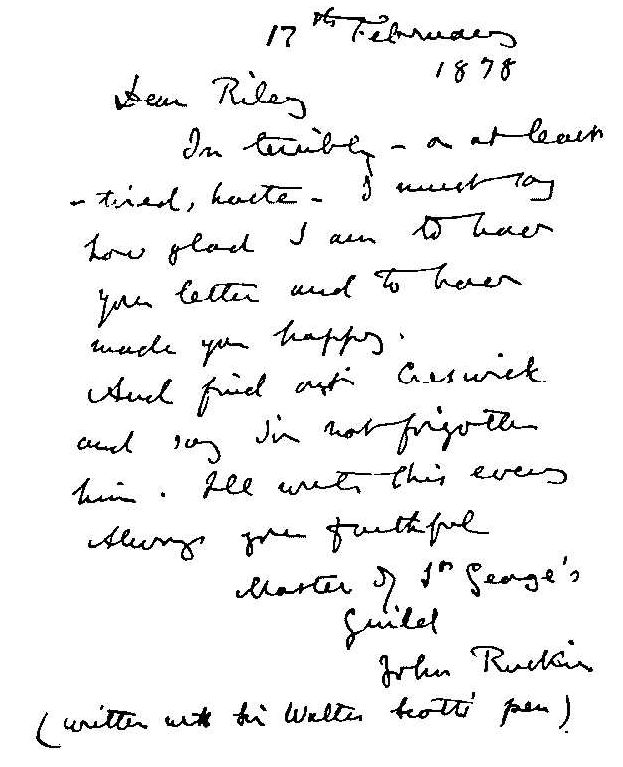 The facsimile reproduced in The Illustrated American (Riley, p. 349)
Ruskin also referred to using Walter Scott’s pen to write a letter on 15 February 1878 to the Canadian fruit farmer and self-declared prophet, Henry Wentworth Monk (1827-1896) (see Viljoen, p. 599).
The parenthetical post-script has even more resonance when one considers that Ruskin would write in his idiosyncratic autobiography, Praeterita,
“I am, and my father was before me, a violent Tory of the old school;—Walter Scott’s school, that is to say, and Homer’s. I name these two out of the numberless great Tory writers, because they were my own two masters.” (Ruskin, Works, 35:13).
Mark Frost has pointed out that Riley appended a note to the original letter that read “written by Ruskin a few hours before an attack of brain fever” (Frost, p. 73). Whatever precisely Ruskin and Riley had agreed, their working relationship was almost immediately thrown into chaos by the collapse of Ruskin’s mental health. The impact of that crisis on the fortunes of the Totley experiment are profitably viewed in the context of Riley’s struggles, of which he left us an elegant and revealing record that amounts to his case against Ruskin.
RILEY’S CASE AGAINST RUSKIN
Before Riley published his article in The Illustrated American, he had signalled his intention to write about his experiences at Totley in the letter he sent to The Commonweal in 1889, in which he had confirmed Mrs Maloy’s claim that he was not one of the original communists involved in the experiment, but had been sent there specifically as a retainer of the Guild. He explained:
“I have been urged, by a late retainer of St George’s Guild, to write an account of my experience at Totley for publication in Good Words but, if I ever do write it, it will be for the Commonweal.” (The Commonweal, 5:171 (20 April 1889) p. 125)
As we have seen, Riley did eventually publish a short, restrained account of his experiences, but in the context of the much broader appraisal of Ruskin and his relationship with him. It appeared neither in Good Words, a monthly periodical aimed at lower middle-class evangelicals and nonconformists, nor in William Morris’s socialist Commonweal, but in the journal, The Illustrated American.
Mark Frost has shown that the retainer who encouraged Riley to publish his story was William Buchan Graham, whose agricultural work was mainly concentrated in the Wyre estate. However, he did also help out at Totley, work that overlapped with Riley’s period as manager between February and April 1878 (see Frost, pp. 216-217).
Among the scholars to have transcribed and analysed William Harrison Riley’s correspondence are Helen Gill Viljoen, Sheila Rowbotham, Sally Goldsmith, and—most comprehensively—Mark Frost. What Riley told friends and colleagues about his relationship with Ruskin, his association with the Guild, and his involvement with the Totley experiment has expanded our knowledge and understanding of this phase of the scheme. Frost, in particular, has detailed the lengths to which some senior Guild trustees were prepared to go in order to contain, and even suppress, negative stories about Ruskin and the Guild.
But no scholar has previously quoted from Riley’s own published account, probably because it appeared anonymously in America. It does have to be admitted, though, that Riley’s anonymity was very obviously compromised by the inclusion of personal details that clearly identified him as the author of the article. The piece even used facsimiles of letters specifically addressed to “Riley”!
Riley told readers of The Illustrated American in 1890 that in a letter written late in 1878 (apparently not in the archives today) Ruskin wrote:
“I am very deeply sorry not to have fulfilled my purposes at Sheffield: but the calamity of my illness ended forever all probability of my doing so. I am now entirely incapacitated from managing other people’s business, and only retain the position of Master till I can find some one else to take it.” (Qtd in Riley, p. 351)
Revealingly, Riley added that “Ruskin’s inability to manage was permanent, not accidental” (p. 351).
Riley’s central criticism of Ruskin was that the people he trusted most did not care for the Guild and its objects, nor were they willing to invest their time and effort in it. Yet, they ended up becoming involved, however reluctant they were to do so. They were ill-informed, unenthusiastic, and begrudging. Consequently, the Guild’s projects were fundamentally undermined.
The Guild was legally constituted as a company limited by guarantee on 25 October 1878. It was necessary for the Guild to be recognised in British Law as having the right to own property. The Board of Trade granted a special licence to the Guild to omit the word “limited” from its name, provided that its income was strictly limited to its chartered objects, namely—as the Sheffield Independent faithfully reported—
“to determine and institute in practice the wholesome laws of laborious (especially agricultural) life and economy, and to instruct, first the agricultural and, as opportunity may serve, other labourers or craftsmen, in such science, art, and literature as are conducive to good husbandry and craftsmanship, for which purpose the association takes power to erect schools, museums, and other educational establishments.” (5 November 1878)
The Guild’s members would be called guildsmen or guildswomen, though the term Companion, already in use by this time, would be more commonly used in practice.
The Guild had several chartered members—subscribers who were liable to guarantee the payment of £5 in the event of the company’s liquidation. Their names, widely reported in the press (including business journals such as the Investors’ Guardian) were Ruskin himself, Dawson Herdson, George Baker, John Henry Chamberlain, Samuel Timmins, Fanny Talbot, Robert Somervell, and Herbert Fletcher. With the exception of Dawson Herdson (1836-1899), Ruskin’s head gardener at Brantwood, they were all senior members of the Guild, solidly middle-class, propertied, and with strong family connections to business or the professions.
The inclusion in the list of Dawson Herdson, a working-class family servant, was a mistake. He had only signed his name to witness Ruskin’s own signature (see Ruskin, Works, 30:7). Herdson, together with David Downs, Joan Severn, professional medical men, and others, had helped nurse Ruskin through the serious illness that had incapacitated him earlier in the year, to the details of which we shall return. The fact that Herdson’s name was widely reported in the press as a guarantor of the Guild, rather than as a witness to Ruskin’s signature, was a particularly unfortunate error that stoked confusion and caused misunderstanding.
Indeed, in his article of 1890, Riley makes rather a lot of what he believed to be the fact of Dawson Herdson’s role as a senior member of the Guild. It was an example, for Riley, or Ruskin’s poor judgement and his mismanagement of Guild affairs. Riley describes Herdson inaccurately as “Ruskin’s under-gardener’, and continues:
“To this day I am quite sure that Herdson has not even the slightest idea of the purposes of the guild or of his duties as a member thereof. Agents who not only did not like the guild, but utterly detested it, were employed by its master to carry out his intentions. It was thus that the work on the three agricultural estates of the guild was made unsuccessful.” (Riley, p. 351)
Riley was unsparing but never malicious in detailing what he perceived to be Ruskin’s shortcomings and failings, particularly in relation to the Guild’s agricultural projects. After quoting the Guild’s eight Articles of Association he remarked:
“Some very good people subscribed their names to the promises, and for a short time gave a ‘tithe’ (‘more or less’) of their incomes to the guild. Three estates were secured and companions placed on them. But the master himself made it impossible for the companions thus placed to live up to the laws as given by Fors, and one by one they were superseded by ‘practical men’, who treated with ridicule the creed of the guild and the designs of its master.” (Riley, p. 351)
Of the two other Companions placed on Guild land and “superseded” by “practical men”, Riley discoursed only briefly. He wrote of the Companion working on the estate in Staffordshire (he meant William Buchan Graham in Bewdley, in the Wyre Forest in Worcestershire), a fellow working-class Companion with whom Riley had extensively corresponded, that he
“waited year after year, ‘toiling harder than a navvy, without a navvy’s wages’. Whenever he ventured to remind the master of his promises, he was told to ‘Be quiet, and wait’, or ‘Be obedient, and wait’; but he toiled and waited—eight years—in vain.” (Riley, p. 351)
Riley had received the evidence of this straight from the horse’s mouth—or, at any rate, the wronged man’s pen—particularly in a letter of 23 July 1888 (see Frost, pp. 185-188).
Referring vaguely to another wronged Companion Militant —without specifying a name or a place—he described how John Guy had worked on the Guild’s estate at Cloughton Moor in North Yorkshire. This is how Riley put it:
“The case of the companion placed in charge of the small estate in Yorkshire was harder still, and too pitiful to be here related.” (Riley, p. 351)
Graham, Guy, and Riley were the most prominent of the “Lost Companions” identified by scholar Mark Frost as the mistreated working-men who laboured hard on the Guild’s estates and whose grievances were, on the one hand, ignored by Ruskin, and, on the other, actively covered-up by senior Guild members determined to protect the reputations of Ruskin, the Guild, and ultimately themselves.
Riley proceeds in his article to address the matter of his own treatment at Totley. He writes as if Ruskin were dead, balancing candour and restraint, and treading more carefully a fine line he first traced in his admittedly less guarded private correspondence which Frost has quoted so effectively and at length. “I, who for a time had charge of the Derbyshire estate”, Riley writes in The Illustrated American,
“waited in vain two years for the master to keep his formally written promises to me. Between the master and the ‘companions militant’ there was always some one hindering, suppressing, misrepresenting, betraying. And I have no doubt that Ruskin’s dementia was chiefly caused by the persons who persistently and continually thwarted him in his purposed work.
“I have dealt as gently as I conscientiously could with this part of my sketches. Writing as a ‘companion militant’, I could not well omit writing of the work of the guild, but I have, with much effort, reduced the writing to a minimum.” (Riley, pp. 351-352)
He had certainly glossed over the gory details, but in his discrete silences he left ample room for readers to speculate. He pulled no punches in convicting Ruskin’s close allies in the senior ranks of the Guild not only of sabotaging what otherwise might have been Ruskin’s good work, but of frustrating him to the point of madness. It is difficult to imagine a more serious charge than this allegation.
In order to understand who Riley had in mind when he wrote of these “hindering, suppressing, misrepresenting, betraying” forces that came to thwart the Guild’s best endeavours and undermine Ruskin’s mental health, we must look at the circumstances in which Riley took charge of the Totley estate, and in particular at the illness which gripped Ruskin just when his attention was most needed at Totley.
First, though, it is worth noting that William Buchan Graham, who had urged Riley to write about his grievances, was disappointed with Riley’s article in The Illustrated American:
“The substance of the article, though carefully and capably expressed, is disappointing. Little new; just what everybody knows. Some remarks strike me as more original, in their application, than enlightening.” (Graham to Riley, 20 November 1890)
Unsurprisingly, Graham took issue with almost all of the sympathetic commentary, let alone the explicitly appreciative remarks Riley made about Ruskin. He even criticized the image of Ruskin used in the article, though he praised the overall standard of printing, thereby damning Riley, or at any rate the publication, with very faint praise.
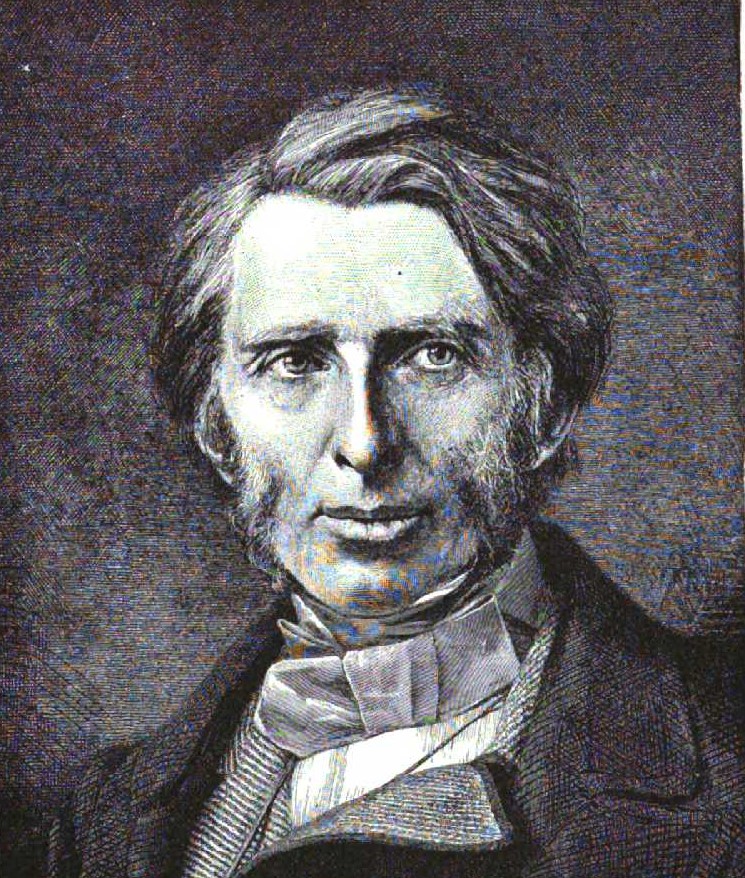 The image of Ruskin used in Riley’s article in The Illustrated American and subsequently criticized by Graham (Riley, p. 348)
Riley was clearly offended by Graham’s criticism, particularly by Graham’s insinuation that he had not written parts of it very well. This provoked Riley to defend himself, but, characteristically, he was at pains to keep the peace, and to placate Graham he almost certainly pretended that he had not in fact seen the article himself. He attempted to endear himself to Graham by speculating that perhaps the careful editors of the journal had “‘blue-pencilled’—deleted” material Graham might otherwise have approved of, and that they might thereby have “emasculated the contribution” (Riley to Graham, 6 February 1891).
He added that his “blood ‘boils’” to think about his experience at Totley, to the extent that he did not feel able to “write coherently” about it at all. Despite Riley’s emollience, this letter appears to have marked the end of the Graham-Riley correspondence. At least, nothing from a later date seems to have survived.
RUSKIN’S MENTAL COLLAPSE:
WRESTLING NAKED WITH THE DEVIL
In the penultimate section of Riley’s essay on Ruskin, he summarized the findings of a Ruskin Society survey of the availability of Ruskin’s works in UK public libraries.
“When we read this (incomplete) list of his writings and consider that Ruskin occupied much time in the practice of various arts, in lecturing, correspondence, conversation, travelling, and the instruction of many protégés, and also that he had frequent and long illnesses, it is not surprising that he found himself unable to attend, as he had hoped and intended, to the management of his [G]uild.” (Riley, p. 351)
The reference to Ruskin’s “long illnesses” is more significant than it at first appears. It was not intended merely to supply Ruskin with a “get-out” clause for neglect and other shortcomings.
Riley’s involvement in the work at Totley had begun just as Ruskin suffered the first of his major mental breakdowns. It was an impeccably inauspicious start to the second phase of the Totley experiment.
Ruskin’s illness was a prolonged psychosis which first struck on 16 February 1878. By the 22nd, he stayed awake all night so that he would be ready to wrestle the Devil naked should he appear (see Viljoen, p. 64). In the weeks leading up to 2 April, Ruskin alternated between unresponsive silences, violent outbursts, manic clapping, and gibbering (see Frost, p. 156). Publication of Fors Clavigera, his monthly letters to the workmen and labourers, was suspended for the following two years.
The prelude to Ruskin’s mental collapse had been characterized by great stress. Whistler’s legal suit against him for libel had to be suspended until Ruskin had recovered. In 1877 there had been a falling-out with Octavia Hill after he heard that she had hinted that he was not always the best judge of character when it came to putting his trust in people. And Totley had long been troublesome: it had been difficult to find a manager for the scheme, and the original group of Sheffield communists seemed increasingly to be at odds with each other and with him.
Riley, who of course lived in Sheffield, appears to have offered to manage things just at the right time, but it is likely that even if he had support from the Swans, George Shaw, and Ruskin himself, others resented the fact that this “outsider” had been imposed on them. With everything that would transpire, Riley would have good cause eventually to agree with Hill’s assessment of Ruskin’s poor judgement.
When we read Riley’s words about the impact of Ruskin’s illnesses on the Guild, then, we must be understand that Ruskin’s first mental collapse—among the worst he would ever suffer, but the start of sporadic mental debility and a protracted decline—cast an ominous shadow over the Riley phase of the Totley experiment.
ENTER DAVID DOWNS
On 6 March 1878, David Downs, nominally Ruskin’s gardener, but in fact a much-trusted agent in his social experiments, wrote a letter to Henry Swan, the curator of Ruskin’s museum in Sheffield, which Swan shared with the local press. It has been overlooked by Ruskin scholars until now. Downs wrote:
“As I have just a few minutes to spare, I take the opportunity to give a line to you about our dear master. I am very sorry indeed to say he is very little better. The following is the report from the doctor this morning: ‘Mr Ruskin’s condition is not materially altered, but he has had a better night.’ Dr Simon is still here from London, and Dr Parsons from Hawkshead, passes every night at Brantwood. It is a most anxious time for us all, as all here love him most dearly, in which I know you all share at Sheffield most heartily. Mr and Mrs Severn are here, and are promoting all they know and can do for his comfort and recovery. His illness is entirely from overwork for the benefit of the people, and his anxiety to promote a good cause. I had hoped to have been in Sheffield at this time, but of course nothing can be said about it now.—With kindest regards to Mrs Swan, I remain, yours very respectfully, David Downs.” (Qtd in Sheffield Independent, 8 March 1878: my emphasis)
Downs could not have been more clear: “[Ruskin’s] illness is entirely from overwork for the benefit of the people, and his anxiety to promote a good cause.” In other words, the Guid was to blame for his mental collapse, and if we take his professed love for Ruskin at face-value, then we can reasonably infer that Riley was right to argue that Downs, as one of the people closest to Ruskin and most trusted by him, did not feel well-disposed to the Guild and the part Ruskin asked him to play in it.
Downs was not alone in pathologizing Ruskin’s philanthropy and blaming the troubling management of the Guild of St George for undermining his mental health and even threatening his life. Joan Severn felt much the same way. Influenced by those closest to him to think ill of the Guild, Ruskin also came to see it as a menace
In his Master’s Report for 1879, for instance, Ruskin stated publicly that he was no longer able to take the strain of dealing with Guild affairs.
“The Master, to his great regret, must also beg the members of the Guild to remember that his knowledge does not qualify him, nor do the nature of his general occupations permit him, to undertake the personal direction of any farming operations, or management of any of the retainers of the Guild, in residence on their lands. Nor was it ever proposed by him, in the constitution of the Guild, that such duties should be entrusted to its Head.” (Ruskin, Works 30:18)
This chimes with the sentiment Ruskin expressed personally to Riley late in 1878. But it is notable that whilst Joan Severn, David Downs, and Ruskin blamed overwork, and particularly the burdens of managing the Guild and its agricultural projects, for causing his mental breakdown, Riley’s analysis, as we shall see, was rather that those who—like Joan Severn, and especially David Downs—essentially did not approve of Ruskin’s philanthropic work, made his management of the Guild impossible, and that by helping to undermine the Guild they sowed the seeds of his madness.
When Downs had told Swan, “I had hoped to have been in Sheffield at this time”, he was referring to the fact that Ruskin had intended him to be at Totley. The extent to which Ruskin expected Downs to be involved in the agricultural scheme there, what Downs’s understanding of that expectation was, and how far Riley had been kept informed about it all, is obscure at this distance. It is likely that a lack of clarity pervaded at the time. This exacerbated the misunderstandings and resentments that built up over a period of two-and-a-half years.
There is more than a hint of pleading in Ruskin’s letter to Riley of nearly a year later (24 February 1879), though he tried to strike a positive tone:
“Whatever real power you have to forward the higher objects of the Guild will find the fullest openings in Sheffield—but everything depends on gentleness and patience.” (Qtd in Viljoen, p. 603, and Frost, p. 170)
This came in the context of a letter in which Ruskin wrote that he was
“very glad that you have been able to make it up with Downs. He means entirely well—and wishes well to all of us. He has not before been put into a position so pleasant to him—and will be less tricky as he gets accustomed to it.” (Qtd Frost p. 170)
This reveals the greatest difficulty of all—a relationship between Riley and Downs that was not merely uneasy, but ultimately impossible. There was fundamental disagreement on the ground between the two men. It was more than a personality clash. They really did not like one another.
Ruskin’s trust in Downs’s (eventual) equanimity would not be met in Riley’s lived experience. Ongoing tension between Riley and Downs, and its disquieting effect, spoiled the chances of successful collaboration and undermined progress at Totley.
We will look at Downs’s background in the next post in this blog series. Readers interested in a profile of Downs should turn to my eighth post https://stuarteagles.co.uk/8-ruskins-gardener-angel-david-downs/
When Ruskin felt sufficiently recovered from his mental breakdown, he sent Downs to Totley on what would be his final mission. Ruskin saw the move
“as the only way possible now to me (and very probably the best I could have found, even had I been as much myself as ever), of letting any touch of my bridle hand be still felt Sheffield-ways […].. I mean [Downs] to live, for a while at least, at Abbeydale [i.e. St George’s Farm], whence he can make little flying visits to me, and ask me a question or two between whiles, as I chop my wood[.]” (John Ruskin to Henry Swan (July 1878) qtd in Viljoan, p. 580, and Frost, p. 167)
Ruskin could hardly have been clearer. Downs was to be his agent, ensuring that his aims and objectives were carried out, and reporting back to him directly.
Downs evidently returned to Brantwood in August, and was then sent back to Totley on the 29th. A long extract from a letter Ruskin wrote to Henry Swan explains matters.
“Downs returns to you to-day, fully instructed as to my purposes, which he will explain and consult with you upon at leisure. My health will not admit of my making any more experiments, or allowing myself to be at all involved in the plans and hopes of the British workman in his present state of semi-knowledge and diluted morals. St George’s work, so far as I can myself see the bearings of it, shall go on decisively in such lands as we now hold, on which it is St George’s opinion that we may advisably grow fruit and corn; and leave shoemaking to be managed elsewhere.
“And I shall therefore put my full force at present on the carrying out, so far as Abbeydale will go, the principles explained in the Fors of January 1877.
“For the money already spent or lost, I shall not trouble the recipients of it. St George was perfectly willing to let them try their hands at his expense, but declines letting them try again. The plan, they must remember, was originally none of his, and he will not be farther troubled with it.” (Ruskin to Henry Swan, 29 August 1878)
There are several important points to amplify here.
First, Ruskin is explicit that he will no longer personally engage with the agricultural work of the Guild, that its scope of operations would not now be expanded, and that at Totley David Downs was his Guild agent. Ruskin had in fact already declared to Henry Swan in July 1878 that
“in all matters respecting the management of the land [at Totley, Downs] is to have whatever authority I could have myself, if I were there, and deserves it much better, seeing he knows more about the business, and understands my mind, by this time, having lived twenty odd years with me, besides taking care of me when my mind was nobody knew where.
“He is also an excellent accountant, and will look into whatever needs eyes, in the current money matters.
“And so I pray of you to help him, and his wife [Maria], to some comfortable lodgement on or near the ground, for the present, and as I am coming north [to Brantwood] again myself on Monday or Tuesday next week, he will soon be able to bring me his first report on matters[.] (Qtd in Viljoan, p. 580, and Frost, p. 167: my emphasis).
I have emphasized Ruskin’s words about “money matters” and the confidence he expresses about Downs’s ability to sort matters out because, taken together with Ruskin’s comment about “leaving shoemaking to be managed elsewhere” in his letter of 29 August 1878, it suggests that the original group of communists might have continued to be involved in the Totley farm to this point (the summer of 1878). The money matter was probably a reference to Ruskin’s cheque for £100 at first accepted and then rejected by the United Friends, and the shoemaking was certainly a nod to the efforts led by George Shaw.
If this reading is correct, then Riley worked with the original communists for about six months. The difficulties between Ruskin and the United Friends could not be resolved while the sage was incapacitated and confined to Brantwood. But, by the summer of 1878, Ruskin had decided that the break with them was final, and David Downs was sent to implement the new policy. Only Riley survived the purge.
Indeed, this version of event was confirmed by Edward Carpenter who explained that when David Downs had appeared at Totley—“the Angel-gardener with the flaming pitchfork” as he called him—Riley “alone of all the Community was allowed to remain on the ground” (Carpenter (1908) p. 208).
The 29 August letter hints that an attempted rapprochement may have been initiated by the original communists, probably with Riley’s support. What else did Ruskin mean when he wrote, “St George was perfectly willing to let them try their hands at his expense, but declines letting them try again”? Perhaps Ruskin was being rhetorical, but as the evidence is that Downs finally made the break clear to the United Friends, it seems likely that Riley worked with Shaw and the rest until the summer of 1878 and that they hoped bridges could be rebuilt with Ruskin.
When Downs returned to Brantwood in August 1878 to give Ruskin his first report, Ruskin told Swan (on the 16th) that he was pleased by Downs’s account of the land and told him that Downs would soon be back on the farm. On the 21st Ruskin confessed to Swan,
“I find myself entirely recalcitrant whenever Downs wants to inveigle me into the smallest attention to the minutest bit of business.”
This was another ominous sign. Given that Riley and Downs were destined to work together—or, anyway, to co-exist—at St George’s Farm from late summer 1878, it is more than likely that the Totley business that was discussed when Riley visited Ruskin at Brantwood in January 1879 focussed on the growing tensions between Riley and Downs (on that visit, see the seventh post of this series, blog #51)
LIFE ON THE FARM
But what can we say about what life on the farm was like, especially after the original group of communists ceased to be involved?
Riley’s life was not one of unremitting misery. In a letter written in 1879, and quoted by Mark Frost, Riley articulated the pride he felt in his work on the Totley estate.
“I mend a wall, grind or file tools, spread muck, dig, hoe, or wheel-stones with satisfaction. Indeed I’m proud of my work, and feel much inclined to show off over much when I go to town in my hob-nails.” (Qtd in Frost, p. 166)
There was, apparently, solid agricultural work done at Totley, and some enjoyment and satisfaction was taken in it. Frost has also shown that Riley had hoped to continue writing for publication, specifically by editing a paper in furtherance of his political campaigning. The lack of assistance on the 13-acre estate, however, left him exhausted from his physical labours and so he seems to have abandoned the idea (see Frost, p. 165).
Another of the joys for Riley was in the people it brought him into contact with and the friendships it helped him to make.
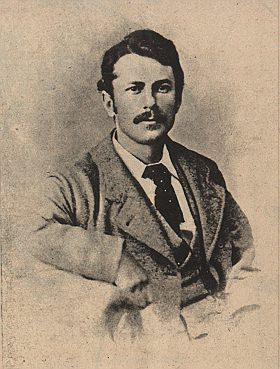
Edward Carpenter, photographed in 1875
Most conspicuous is Edward Carpenter, who provides a connection between every phase of the farm’s radical Ruskinian heritage. He knew some of the original communists such as Joseph Sharpe and Mrs Maloy, he volunteered to work at the farm under Riley and Downs, and he recommended George Pearson as the right man eventually to take it on as a tenant of the Guild of St George.
Mark Frost unearthed a letter from Riley to an unidentified socialist friend written at Totley on 22 May 1879. Riley describes Carpenter therein in some detail, revealing how well he had got to know him. He was a graduate of Cambridge where he had been a fine oarsman, Riley told his friend: he was originally from Brighton, had abandoned holy orders, and was now giving extension lectures in astronomy. Riley even shared one of Carpenters jokes. He explained that Carpenter
“has been working here lately. He is a clever fellow—and thoroughly good. He gives one encouragement respecting the advancement of Democratic ideas among the ‘educated’ people. He is one of our converts [i.e. a socialist] and, I suspect, will be heard of before long.” (Qtd in Frost, p. 166)
How right his prophecy proved to be.
Sally Goldsmith has also enumerated useful information about Carpenter’s involvement in the work of St George’s Farm. She quotes a letter from Carpenter to Walt Whitman in which he told him, on 28 March 1880, that “in a month” he “hope[d] to be at work out in the country near here—at first on some land of Ruskins [sic]” though not perhaps for long (qtd in Goldsmith, p. 70: available to view online here, <https://whitmanarchive.org/item/man.00027>).
Ruskin himself wrote to Carpenter on 27 July 1880 that it was “curious” Carpenter “should have worked with [him] so long” without telling him more about himself (Ruskin to Carpenter, 27 July 1880, qtd in Eagles (2011) p. 62).
It is clear when taking the three pieces of evidence together, that Carpenter worked on-and-off at the farm over a period of more than a year between the summers of 1879 and 1880, mainly alongside Riley, but also perhaps after his time, when Downs was in sole charge.
For Carpenter, this experience on Ruskin’s land at Totley was a crucially formative one, and a prelude to his celebrated establishment in 1883 of his own smallholding idyll just a few miles away at Milthorpe.
The visitor books of Ruskin’s museum in Walkley also reveal that Carpenter visited with his friend and disciple, Goldsworthy Lowes Dickinson, in September 1886.
There were those, besides Wiliam Buchan Graham and Edward Carpenter, who joined William Harrison Riley and David Downs in assisting with the work of the farm at Totley. It must be noted that this period was one of enormous hardship for working families in Sheffield, especially for the many employed in the iron industry.
In evidence of this point, take the words of the Secular Chronicle for 1 December 1878 on the subject of “the distress at present so keenly felt in Sheffield”.
“It appears that, in consequence of the continued depression in trade, and the inclement weather, the most fearful and wide-spread depression prevails amongst the working classes of that town. Last year the distress was so great that nearly £11,000 was expended in [poor] relief, but, owing to the continued bad trade, the distress is far more severe and general than was the case last year. At the works of Messrs. Cammell & Co., the ironworkers have only had fourteen days’ employment during the last three months, and at other large ironworks in the district there is also a great scarcity of work.
“At Brightside and Attercliffe the destitution is terrible. An idea of the straits to which some of the working men are reduced may be gained from the fact that at one of the ironworks, a few days ago, the men on the night shift were so weak from lack of food that they were unable to do the work, and fell insensible.” (10:22, p. 259)
This also underlines what a bad time it was for Ruskin and the original group of communists to have effectively fallen out.
The Guild’s accounts for 1878 list among its expenses manure, seeds, plants, food for poultry and pony; tools, tolls, haymaking, and the poor rate, all of which give a sense of the work done (Ruskin, Works, 30:115). They also list payments to four individuals, other than Riley and Downs, who evidently assisted with aspects of the farm work: £2 10s was paid in wages to E. Richardson, probably Ebenezer Richardson, one of the original communists; J. Woodbine was paid £1 18s for “assistance in fence mending etc.”; Anthony Heaton was paid 6s “for assistance in weeding”; and Seth Green was paid 8s. “for assistance in hoeing”. Of these, it is only possible positively to identify and say anything more of Seth Green (1853-1934). He was the son of a file smith, William Green (who himself farmed 16-acres of land in Totley in the 1870s). Having married in 1874, Seth had a young and growing family when he worked at St George’s Farm. At that time he lived at the Rolling Mill, Totley. Local newspapers reported that in September 1878 he told an Inquest that “he was a file cutter by trade, but was at present labouring for Mr Potter, builder”, confirming that he took on casual work in this period of severe economic depression (Sheffield Independent, 26 September 1878) & Derbyshire Chronicle, 28 September 1878).
Ruskin appears to have visited St George’s Farm twice: first, when he was in Sheffield to show Prince Leopold around the museum treasures in Walkley in October 1879 and, again, when he was in Sheffield in February 1880 (see Goldsmith, p. 65). Ruskin wrote of the former visit that he had “tea in state” at Totley and that Downs was in “great feathers” showing him a row of cabbages at the farm (qtd in Frost, p. 171).
The latter visit is best viewed through the prism of Riley’s growing dispute with Downs.
RILEY Vs DOWNS
Edward Carpenter recalled that Riley, “the harum-scarum reformer” and David Downs,
“the very old-fashioned and John-Bull-like retainer of the Ruskin family could hardly be expected to be very happy together; and so at last they had to part company.” (Carpenter (1908) p. 208)
Riley, too, it is worth noting, described Downs as a “John Bull of a gardener” in private correspondence in May 1878, inviting one to speculate that the friends referred to Downs thus in personal conversation (qtd in Frost, p. 168).
Carpenter’s testimony confirms that Riley’s departure from Totley was the result of a profound personality clash with Downs and fundamental disagreement about how to run the farm as a Guild project. Given that Downs had been the apparently loyal Ruskin family servant for decades, it is hardly surprising that his word held the greatest sway with Ruskin. Moreover, Downs had first been employed by John James Ruskin at Denmark Hill. For Ruskin to have thought ill of the family gardener, he would have had retrospectively to confront the good judgement and authority of his own beloved late father. Riley was at a distinct disadvantage.
But was Ruskin’s faith in Downs well-placed? Let us pause to examine two pieces of evidence.
Sir Edward Bagnall Poulton (1856-1943), who became a noted biologist, and would be the Hope Professor of Zoology at Oxford for 40 years from 1893, recalled his brief participation at Hinksey and had good things to say about Downs.
“[Ruskin’s road-digging] disciples were directed in their exertions by Ruskin’s gardener, a man as round and fat as his master was tall and spare—‘the sort of man who walks about with a big belly and a pot-hat’, to quote an ingenious description I once heard of the typical gardener-foreman. But David Downs, who was a capital worker himself as well as an excellent foreman, only possessed the first-named qualification. A plate in Mr [Henry] Taunt’s recently published work—a valuable record of the Diggings—clearly shows that he wore a soft felt hat.” (Poulton, p. 245)
Downs’s ample proportions were confirmed by Henry Swan’s eldest son, Howard, who painted a picture of a less flattering personality who enjoyed a complex relationship with Ruskin.
“[Ruskin’s] servant Downs was his devoted slave. ‘Downsie-Pownsie!’ he would say, in smiling accents, ‘was he not well? Poor old Downsie!’ as the old man hobbled along slightly rheumatic, when staying at his last home in the St George’s Farm [at Totley], the other side of the hill [from the museum at Walkley].”
Howard Swan’s recollections try to capture Downs’s voice—including his way of speaking and his accent (a Hampshire burr). Swan reveals a mixture of scepticism and loyalty in the servant, condescension in the master (and perhaps a degree of snobbery in the writer himself).
“Old Downs used to relate many an anecdote of ‘the young Master’, as he called him.
“‘He were a funny man,’ he said; ‘once, when we went back to Switzerland, he says: “Come along, Downsie; let’s go and see if it is still there!” and I trots along’ (the old man puffed in example—he was fat). ‘I wonders what “it” was. Well, we goes down to the lake, and he points and he says, “Yes, there it is—there it is, Downsie!” “Where?” says I. “Why, there! Don’t you see it?” I saw nothing except an old stump in the water. “Why, the old stump; there it is, the same as ever! I used to come and sit there fourteen years ago! And there it is!”’ A curious example of Ruskin’s vividness of remembrance of detail.
“‘We were marching along in the Alps,’ said Downs, ‘him and Mr Ward [i.e. William Ward (1829-1908)]. Ah, Mr Ward was a gentleman; he could speak French like a native. Well, they were walking along, and talking, talking, talking—and I was getting hungry, I was. So I asks, “Beg pardon, sir; is it time for dinner yet, sir?” “No, not yet!” Well, I s’pose he saw my face fall, for he says, “Oh, it’s you who are hungry, eh, Downs? Well, go along on and order lunch; there’s the inn over that next hill—and order us something nice, there’s a good Downsie!” So I went, and I knew what he liked, so I ordered a dish of mushrooms and milk—and it was good, I promise you.’ Such was the master to his man.” (Ruskin, Works, 34:718)
When the Sheffield Independent republished most of Howard Swan’s article, which first appeared in the Westminster Gazette in 1900, its editor was careful to leave these remarks about Downs out, lest Downs’s children might read them and take offence.
Riley addressed the matter of his personality clash with Downs directly in his anonymous article he wrote for The Illustrated American.
“David Downs, who had acted as head-gardener for Ruskin’s father, and afterward as gardener, steward, and St George’s special agent for the son, frequently said of the father, ‘Ah! he was a gentleman’; and (referring to the son) asked, over his beer [Riley himself was teetotal], ‘Why can’t he spend his money like a gentleman?’ And many thousands of conservative Britons asked the same question, in various sets of words, over their beer—or champagne.” (Riley, p. 347)
As far as Riley was concerned, Downs did not believe in the Guild, and had a conservative political outlook.
One would expect a published account to be more guarded than private correspondence, but not necessarily any less honest. And sure enough, the letters Riley wrote to fellow working-class Guild Companion, William Buchan Graham, examined by Mark Frost, are considerably less restrained than Riley’s published article. After all, they represent exchanges between men with a mutual grievance whose shared discontent with their experiences must have emboldened them to unburden themselves. Whereas Riley merely hints in the article about the quantity of beer Downs drank, he told Graham that Downs was “a great beer drinker” and “seldom completely sober”: he even took offence when the teetotal Riley refused to join him in a pint (qtd in Frost, p. 168).
Riley also thought that Downs selfishly and actively schemed to bring about the Guild’s failure—not so much for Ruskin’s perceived benefit (as Downs’s own testimony to Henry Swan quoted earlier might suggest), but for Downs’s own sake—to bring his unwelcome work as Ruskin’s “special agent” to a merciful conclusion (see Frost, p. 168).
Riley even alleged that Downs deliberately tried to shake his own faith in Ruskin, and Ruskin’s faith in him, by indiscreetly telling tales that cast each in an unflattering light—Downs’s lips having no doubt been loosened by beer.
Riley felt that his own good faith was confounded by Downs. He alleged that Downs left two sheep to die by strangulation: Downs did not consider it his business to interfere in the running of the farm by intervening. Worse still, he took offence—or affected to do so—when Riley interceded to save them.
Riley’s most serious claim of all was that he had heard Downs say that he “hated” Ruskin from the bottom of his heart (see Frost, pp. 168-169). There is no way of testing such an allegation, and even if Downs did say as much in Riley’s hearing, it may have been little more than the intemperate raving of a drunk.
Nevertheless, the extent of Riley’s criticism of Downs is not characteristic of him, and the length of the charge-sheet with which he indicted him is revealing in itself. We have seen, too, that Riley’s negative assessment of Downs was supported to some extent by Howard Swan’s candidly unflattering pen-portrait.
For all Riley’s animus for Downs, he ultimately blamed Ruskin for putting his servant in an impossible position in the first place, by sending him to Totley as the “special agent” of an organisation he neither understood nor sympathetically supported.
Even if Riley is right to convict Downs of actively trying to sabotage the Guild, it is more plausible to think of it as a destructive act of love than of hate. The issue boils down to two very different interpretations: Downs blamed the Guild for Ruskin’s madness; Riley blamed the Guild’s doubters, like Downs, who were among Ruskin’s most trusted ‘friends’, for driving him mad by frustrating and undermining his Guild.
Downs and Riley both had a point. The Guild caused Ruskin to overwork, and created unique stresses, yet he also asked too much of his servants and Guild retainers. The doubters might have wanted the destructive distractions of the Guild to end for Ruskin’s sake as well as their own. But their unhelpful influence only made the problems of the Guild and its retainers all the greater. It created a cauldron of antagonisms. The Guild’s projects failed and Ruskin was increasingly stressed and disappointed.
It must also be admitted that the picture Riley and Howard Swan paint of Downs was at odds not only with Poulton’s account of him, which we have already considered, but also with the testimony of the Harvard historian, Prof. Ephraim Whitman Gurney (1829-1886). When Gurney and his wife were rowed to Brantwood for tea in July 1876, Gurney wrote revealingly of both Ruskin and Downs in a letter to Charles Eliot Norton:
“we have not had a more delightful evening on this side of the water, and Ruskin was everything that is considerate and courteous and kind. He […] talked delightfully, with a slight twinkle of humorous enjoyment of his own extravagance, when he trampled upon all the existing arrangements of society and augured its speedy downfall; […] we tore ourselves away at half past ten or later; and instead of walking home as we had arranged to do, the faithful Downs […] insisted on rowing us back as well as over.
“It was pleasant to hear him talk of his master and of his own pride in appearing in person in the Fors. The row back in the dusky light was an appropriate close to an evening so delightful in all ways.” (Bradley (ed.), 2:134-35)
RILEY’S DEPARTURE FROM TOTLEY
Riley probably stayed on at St George’s Farm into the summer of 1880.
“Just before I last left England, in the fall [i.e. autumn] of 1880,” he wrote in his anonymous article, “Ruskin invited—or rather ordered—me to take charge of the first of the St George’s Scripture Schools” (Riley, p. 350)
He quickly added that he did not consider himself competent to teach any of the subjects in which Ruskin intended the schools to instruct people, namely “(besides Scripture) music, drawing, illumination, and black-letter writing [i.e. traditional calligraphy]” (Riley, p. 350).
That Ruskin should have considered Riley suitable for such work implies that relations between them remained good up to this point. Ruskin would appear to have had a good deal of faith in him. On the other hand, the apparently high-handed nature of the “order” falls considerably short of respect, and Ruskin had misjudged both Riley’s capacity and willingness to comply..
In terms of when this would have been, the subject of the scripture schools was very much in Ruskin’s thoughts in the early part of 1880. They were also at the forefront of Henry Swan’s mind when he addressed the Ruskin Society at Manchester Town Hall on 9 February 1880 on “Scripture Schools according to St George” (see Eagles (2024) p. 91).
Perhaps it was Riley’s negative response to Ruskin’s order that caused the final rupture between them. It certainly exasperated Riley, and seems to have been among a clutch of last straws for him.
In a reference to one of Ruskin’s visits—probably the second, in February 1880—Riley wrote in a letter:
“Just previous to the visit I had hurt my back with digging heavy clay and [Ruskin] told me to rest awhile. After he left I told the agent [i.e. Downs] what Ruskin had said and he replied ‘Then I suppose you must rest’. I rested for two days and the agent complained of it to Ruskin, who sent me, through the agent, an open letter dismissing me in terms that were harsh and exceedingly unjustifiable.”
Furthermore, Ruskin did not allow him a “fair hearing” (Riley to Graham (15 February 1889) qtd in Frost, p. 171).
Matters deteriorated rapidly. A remark in the Sheffield Daily Telegraph indicates that work on a large part of Totley’s 13 acres was not obvious to locals. Believing that Ruskin had purchased the farm “for the purpose of erecting dwellings and founding homes for the working classes after his own ideas”, the paper reported that “the ground is still unoccupied” (19 June 1880). They probably meant, merely, that it had not been built upon, but it also seems likely that much of the site remained largely unproductive. Perhaps Riley was incapacitated for more than two days in his final period at Totley.
A letter from Ruskin to Henry Swan at the museum in Walkley gives the Master’s assessment of the Riley-Downs dispute in the summer of 1880. It seems to date Riley’s departure to late June/early July.
“The help that came to me from the unseen world was in the shape of an anonymous letter—abusing Downs—for obeying my orders on the spot. Downs must be let alone and must have people he likes about him.—Either Riley or he is a liar, and I believe Downs. You don’t suppose that I can allow the colonels of regiments to have the men quarrelling with them.
“I believe Riley to be half mad—he would certainly make me wholly so—if I had more to do with him.
“You may get him employment at 10/- for 6 hours a day elsewhere if you like.
“This is seriously meant.
“So is all the rest for that matter, but you might have thought the last sentence ironical.” (Ruskin to Swan, 2 July [1880])
The full significance of this letter has not hitherto been understood, because it was speculatively and incorrectly dated to 2 July 1877 by William Allen (George Allen’s son, who catalogued the correspondence from Ruskin to Henry and Emily Swan). The letter was accordingly dated 1877 when it was quoted by both Helen Gill Viljoen and Mark Frost (see Viljoen, p. 603, and Frost, p. 159).
It is clear from a careful examination of the context, however, that the letter dates from 2 July 1880.
The main clue is that it contains references to the proofs of Elements of English Prosody. Said proofs were only produced in late June/early July 1880. It also includes references to ongoing work to catalogue the Guild museum’s coin collection, discussions about which otherwise dominated Ruskin’s letters to Swan in the summer of 1880 when his interest in coins was particularly strong. Finally, Ruskin indicates that he will address the next letter of Fors to the trade unions—a promise that he fulfilled in Letter 89, published for September 1880 and dated 31 August.
The misdating of the letter to 1877 is particularly unfortunate as Ruskin’s comments about Riley in relation to the Totley project are inexplicable in that context. In July 1877, Riley had just published the first issue of his Sheffield-based newspaper, the Socialist. The mis-dating has caused confusion about whether Ruskin and Riley might have collaborated before February 1878. We can now be certain that they did not.
In fact, then, given that the letter can now confidently be dated 2 July 1880, Ruskin’s comments about Riley—withering and dismissive as they are—constitute Ruskin’s last words about him during his involvement in the Totley experiment.
Edward Carpenter tried without success to intervene with Ruskin on Riley’s behalf in the spring of 1880 when the relationship was breaking down. This called forth Ruskin’s dismissive declaration that Riley “liked smoking better than digging” (John Ruskin to Edward Carpenter, 18 May 1880, qtd in Eagles (2011) p. 61). In fact, though, Riley seems to have liked and to have been reasonably good at digging, but it is also true that he did like to talk and smoke: “he would talk brilliantly, over innumerable pipes, for hours at a stretch” (Labour Leader, 15 November 1907)
By 1881, Ruskin’s attitude to Riley had hardened even more. He told Swan, parenthetically—in a letter in which he reprimanded his curator for allegedly snubbing David Downs—that
“of all the blackguards I ever came into collision with in my long life, [Riley was] out and out the worst” (30 November 1881, qtd in Frost, p. 171, and partially qtd in Viljoen, p. 603).
Later still (1889), Ruskin commented of Riley that he
“was no friend of mine. I tried him as an exponent of modern liberalism, and was as little pleased with the result as those members of your League were!” [here referring to Morris’s Socialist League, but in fact meaning Mrs Maloy and her communist friends first involved at Totley] (The Commonweal, 5:179 (15 June 1889) p. 189. This remark was widely syndicated in the national and local press, from which it was quoted in Ruskin, Works, 34:619-620.)
ASSESSING THE RILEY YEARS
The farm at Totley can hardly be said to have been a success in the years that it was under the joint or rival management of Riley and Downs. Theirs was not merely an unwilling partnership, it was not a partnership at all, but an unhappy coexistence in which fruitful collaboration proved impossible. The fundamental difference in their personalities was matched by their sharply contrasted understanding of Ruskin’s purpose. Their political outlooks also seem poles apart.
Moreover, there were no agreed lines of authority. It was never really clear who was in charge of what and whom. No sooner had Ruskin apparently authorized Riley to cultivate his own acre and distribute others, than he seemingly sent David Downs in as supervisor and spy. Ruskin’s half-paranoid actions, which were the result of his own lack of capacity, sowed bitter seeds of mistrust that first destabilized and then undermined the scheme. Ruskin ought to have known that Riley and Downs were very different people and to have foreseen that they were likely to clash.
But Ruskin was not exactly in his right mind. How far he can be held responsible for his poor decision-making, especially in the first half of 1878,, must remain in doubt. His mental health was severely impaired just at the point that Riley got started. After Downs helped nurse him through his dangerous psychiatric crisis, Ruskin added a sense of personal debt to an already strong sense of intergenerational loyalty to the man. It was inevitable that he would take Downs’s side in any dispute.
Sadly, in this instance, Ruskin’s loyalty was misplaced. Downs’s own testimony supports Riley’s assertion that some of the people closest to Ruskin really did not approve of the Guild of St George and Ruskin’s social philanthropy. This was partly owing to a lack of imaginative and political sympathy, but it was also motivated by a justifiable anxiety about the harm caused to Ruskin’s health by the burden of managing such ventures. No doubt Joan, Downs, and many friends and fans felt that Ruskin’s energies were more profitably spent in writing his books and giving his lectures. And no doubt, either, they feared for his reputation, stung by a great deal of vituperative mockery in the press, some of which hinted that Ruskin’s schemes were not merely eccentric but insane.
Delivering his verdict on Totley from a practical point-of-view, in the regular column “On Men and Things”, the Sheffield Independent’s Le Flaneur wrote on 22 December 1881:
“Judged at by its financial result—the last which would influence Mr Ruskin—St George’s Farm, at Totley, is anything but profitable. The balance-sheets of the Guild of St George for 1879 and 1880 show that in the latter year, whilst the sale of the produce amounted to £52 5s 5d, the expenditure was £167 11s 1d; and that in the former year the wages account was £170 10s 2d, whilst the sale of produce realised only £34 18s 2d. The tenant of a farm which yielded no better results than these would soon find himself in the hands of his lawyers and accountants.”
The blunt truth of the concluding sentence is undeniable.
Yet, as badly treated and as disappointed as Riley felt, he continued to believe in the essential value of the ideal Totley represented to him and the original group of United Friends. In November 1890, by which time he had emigrated to the USA, he joined with other “socialistically inclined men” and together they appealed to others to support them in establishing a new co-operative village in New England. It was, at least to some extent, a plan to realise afresh, on American soil, the aims of the group of Sheffield communists with whom Ruskin had met in Walkley in the spring of 1876.
Riley’s new group planned to start their venture with a 65-acre farm where they would make men’s clothes and shoes: “we are tired of the din of city streets”, Riley wrote, “and of the cannibalism of competitive commercialism, and seek peaceful lives under healthy conditions” (Co-operative News, 15 November 1890; Miners Journal (Pennsylvania), 11 December 1890). They appealed for £600 to buy a neighbouring fruit farm. It all sounds very familiar, loudly echoing the words of George Shaw and George Dawson.
And, with wearisome predictability, nothing seems to have come of it. Totley had not spoiled Riley’s appetite for such efforts, but nor had his experience in Derbyshire apparently taught him the vital lessons that might have made the crucial difference in subsequent attempts to realise the dream. Indeed, according to his obituary in the Labour Leader, Riley found in America “no fruit, but bitter disappointment from many fresh projects on a Socialist basis” (15 November 1907). Ruskin and Totley had at least prepared him for the worst.
The historian Sheila Rowbotham wrote that the communist and socialist phases of the Totley experiment collapsed “bristling with acrimony and disappointed hopes” (Rowbotham (1993), p. 264). It is a bleak assessment, but the facts make it an irresistible one.
Next time, we look at what happened to the farm when it was in the sole charge of David Downs, and then transferred to George Pearson. Finally, we assess Totley’s wider legacy…
Sources
Armytage, W.H.G: Heavens Below: Utopian Experiments in England, 1560-1960 (London: Routledge & Kegan Paul, 1961)
Bradley, J. L. (ed): The Correspondence of John Ruskin and Charles Eliot Norton (Cambridge: Cambridge University Press, 1987)
Carpenter, Edward: “The Minstrel Communist” in The Commonweal (9 March 1889) pp. 74-75
Carpenter, Edward: Sketches from Life in Town and Country, and Some Verses (London: George Allen, 1908)
Eagles, Stuart: After Ruskin: The Social and Political Legacies of a Victoria Prophet, 1870-1920 (Oxford: Oxford University Press, 2011)
Eagles, Stuart: Ruskin’s Faithful Stewards: Henry and Emily Swan (Reading: Ruskin Research Blog, 2024)
Frost, Mark: The Lost Companions and Ruskin’s Guild of St George: A Revisionary History (Anthem Press, 2014)
Goldsmith, Sally: Thirteen Acres: John Ruskin and the Totley Communists (Guild of St George, 2016)
Maloy, M.A.: “St George’s Farm” [a letter] in Commonweal, 5:176 (25 May 1889) pp.164-165
[Riley, William Harrison]: “John Ruskin” (By a Companion of the Guild of St George) in The Illustrated American, vol. III, no. 28 (30 August 1890) pp. 347-352
Rowbotham, Sheila: “‘Our Party is the People’: Edward Carpenter and Radicalism in Sheffield” in Protest and Survival: Essays for E. P. Thompson, eds. John Rule & Robert Malcolmson (Merlin Press, 1993) pp. 257-278
Viljoen, Helen Gill: The Brantwood Diary of John Ruskin (New Haven, CT: Yale University Press, 1971
Please send feedback to contact@stuarteagles.co.uk